

Link to the slides.
Link to part 1 (30 AD - 325 AD).
Link to my intermission reflection.
Glory be to the Father, and to the Son, and to the Holy Spirit, as it was in the beginning, is now, and ever shall be, world without end, amen. Hello and welcome back to part 2 of What the Nicene Creed Actually Means: Christology Wars. In the first part, I covered the pre-history to the Arian conflict, and then the Arian controversy itself from 300 to 325 AD, through the first council of Nicaea. If you haven’t watched that yet, I encourage you to do so because that video has important context. This video will now continue through Arian Controversy from 325 AD until 381 AD, when the controversy was finally resolved at the council of Constantinople, and the Nicene Creed we use today was finalized. Hope you enjoy this video, and please subscribe, like, and comment what you think about the presentation.
Christology Wars: The Arians Strike Back (325-360 AD)
So when we last left off, we had just finished the first council of Nicaea in 325, which produced an anti-Arian creed and condemned Arius and his doctrine. So, we would expect the conflict to be over right? Well, in fact, no, the conflict would be far from over, and as we will see Nicaea faced strong rejection in the following decades as the Arians returned to power.
A Critical Error in the Nicene Creed of 325
So this all happened because the Nicene Creed of 325 contained a critical error in one of its anathemas. So stepping back, if you’ll remember, we had four broad camps of proto-Orthodoxy going into the council of Nicaea: Arianism, Semi-Arianism, Orthodoxy, and then Modalism. So Arianism was basically condemned by the three other camps working together; however, those three camps themselves had substantial differences between themselves, which became more apparent after the council of 325 and brought disunity to the church as well as suspicion on the creed that had been produced. So the critical error is in this sentence: “[those] who allege that the Son of God is of another hypostasis or ousia...these the Catholic and Apostolic Church condemns”. So specifically, the error is with the word hypostasis. We had previously covered the words ousia and homoousios, in terms of declaring the nature of Jesus to be completely equal to the nature of the Father’s. However, this word hypostasis goes a step too far, because hypostasis basically means an existence or a manifestation, of like a nature in concrete reality. So basically, this sentence is saying that Jesus and the Father share the same existence, which is very problematic if you think about it. It’s basically saying that Jesus and the Father are the same exact being or person. As Hanson notes, this anathema was “a confusion of terms so disastrous as to render its eirenic function virtually worthless”, which is very crazy and unfortunate. And the problem is that this basically leads to the heresy of Modalism. Remember…”that’s modalism Patrick!”. Now, the funny thing is that, unknowingly, many of the bishops who signed the creed actually had substantial theological differences with each other. For example, some of the Nicenes were actually modalists, such as Marcellus and Eustathius. So if you could imagine how crazy this would be, that several of the bishops sat through Nicaea actually believing that God was only one person, and as they’re sitting there nodding and agreeing with everything that is said, it’s going completely over their head that everyone else in the room actually thinks God is three people. And also remember that the Creed completely failed to clarify the doctrine of the Holy Spirit. So as this meme explains: there was actually a diversity of views amongst the people who signed the creed. “Eustathius I can explain; you think the Holy Spirit is God? You think the Holy Spirit is a person? You guys think God is more than one person?”.
Modalism Explained
So yeah, this is the diagram explaining how modalism works. Pretty easy to understand, God is just one person, who manifests as the Father, Son, and Spirit depending on the situation. And he also assumed a human nature from Mary, when He came down to Earth as Jesus. So obviously, there’s a lot of problems with this heresy. First of all, we run into the same situation as in Arianism, where God basically exists alone by himself for all eternity before creation. Which is such a dark, depressing, and lonely existence and I don’t think portrays a God whose fundamental nature is love. But then it gets even worse, because not only is God alone in eternity past, he’s also pretty much alone even after creation as well. When you look in the Bible, there are just so many beautiful expressions of love between the persons of the Trinity. You have so many of the psalms, were Jesus, prefigured by David, is just calling out to God the Father for help, for rescue, for vindication, and just has the total faith and assurance in that relationship, and the patience and humility to wait for the Father. And then just in the gospels themselves there are so many beautiful moments featuring the Trinity, such as the baptism of Christ, and then just Jesus praying in the garden, begging God the Father for another way, but then saying “not my will, but your will be done”. “Not my will but your will”. Think about how much these narratives get destroyed in modalism. In the Garden Jesus may as well just said “not my will but MY will”. You know? And then all these times in the gospels that portray Jesus as praying to the Father, he’s just praying to himself and then pretending to pray to another person, just to trick his disciples or something, but in reality there’s no real relationship there. So modalism really just robs a lot of the beauty of Christianity and the inter-personal relationships of the Trinity. And unlike a lot of the heresies in this presentation that don’t overtly appear today, Modalism is still very much alive and I encounter people in the Church all the time who believe some variety of this heresy. And I bet this negatively impacts our spiritual lives in some ways. Like, I believe that modalism could strongly prevent you from fully understanding and experiencing the love of God, just because you don’t think of the Godhead community as loving each other, and really seeing that as the fundamental reality that then spills over into our own lives in the ways God loves us and we love each other. I also wonder if modalism really prevents us from relating properly to all the members of the Trinity. For me personally, I think for most of my life I only prayed to God the Father, I would say for most of my childhood and even through college. It’s actually only relatively recently that I even intentionally direct prayers to Jesus or the Holy Spirit, and these are such different experiences that I think we are all supposed to have, because the Godhead functionally relates to us differently in each of the persons. So yeah, I would encourage you to think about whether you feel echoes of Modalism in your own spiritual life.
Arianism 2.0: Semi-Arianism
So because the first Nicene Creed was compatible with Modalism, many bishops actually ended up rejecting it, and as a result this opened the door up to Semi-Arianism to become more dominant in the Church. And yes, Semi-Arianism is a huge generalization and in fact there were several different schools of thought in this camp, but we don’t have time to go into all of those so I’m just calling them all Semi-Arianism. So Semi-Arianism can basically be thought of as Arianism 2.0, because it has a similar philosophical basis as Arianism in terms of protecting God from condescending or suffering. However, this heresy is particularly lethal because it actually avoids the third rail that Arius constantly ran into, which is claiming that the Son is a created being. And so Semi-Arianism says that the Son is also eternally pre-existent, just a lesser form of Divinity than the Father. This theology sounds palatable to most people because it sounds like it is giving proper honor to the Father in His uniqueness, without sounding too irreverent of the Son because Jesus is still called eternal.
Semi-Arianism Trinity & Cosmology
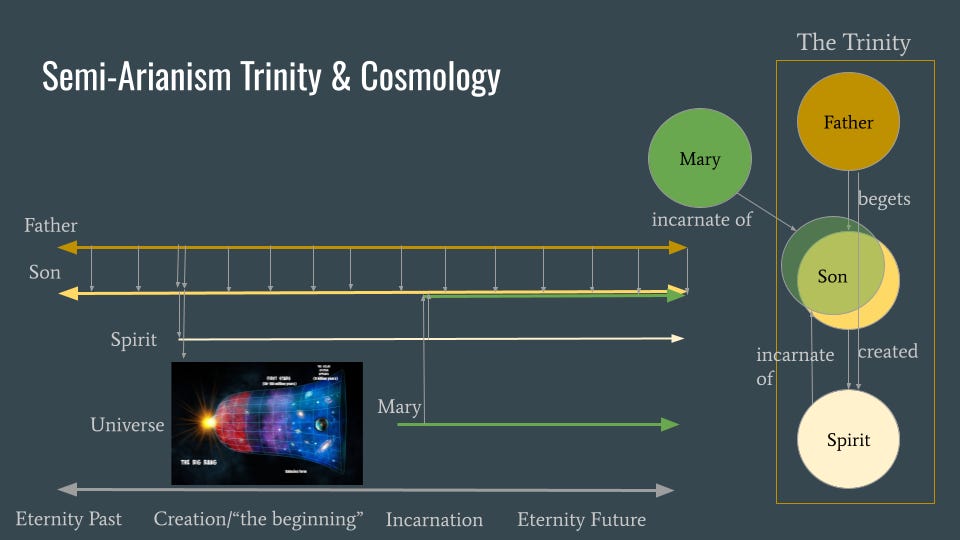
So looking at the Trinity and cosmology diagrams, we can see the similarities and differences between Semi-Arianism and Arianism. Semi-Arianism holds that the Father eternally generates the Son, just as Nicaea does, however the Son is a lesser gradation of divinity compared to the Father. In general, most Semi-Arians believed that the Holy Spirit was a created being.
Why Not Just Read Scripture?
So at long last, let’s focus on the issue of Scripture in this entire conflict. Why didn’t they just read the Bible? After all, shouldn’t scripture clearly say that Arianism and Semi-Arianism is false? After, John 1:1 says “In the beginning was the Word, and the Word was with God, and the Word was God”, right? Well…it’s not that straightforward. Let’s look at one example of how Arians responded. In John 1:1, the word used for “God” is theos, which can actually have a semantic range of meanings from God, to gods, to lesser divinities, and everything in between. So if the intended sentence were actually “and the Word was a god”, then this would look exactly the same in the Greek. There’s a very relevant quote from RPC Hanson’s book on this: “It must be understood that in the fourth century the word ‘God’ (theos, deus) hadn’t acquired the significance which in our twentieth-century world it has acquired (mainly in fact as the result of the creed of 381 having, so to speak, entered the bloodstream of European culture), viz. the one and sole true God. The word could apply to many gradations of divinity and was not as absolute to [4th century Christians] as it is to us.” So in other words, whenever something is called “God” in the Bible, this is not guaranteed to mean, “exactly equal to God the Father”. Rather, it can be a title of honor for a being that is less than God, and in the ancient world they accepted these different gradations of divinity. It’s only now, since we live in a post-Nicene world, that today when we read “God” in the Bible we strongly interpret this as exact equality with God the Father. However if we are strictly just looking at the scriptural evidence itself, without the benefit of presuming Nicaea to be true (since that is the exact topic of the Arian controversy), then it does not specifically follow that all instances of Scripture that call Jesus “God” are claiming consubstantiality. And also, just a disclaimer, this is just one out of many arguments employed by Arians to explain the high Christology passages. They had other tricks as well and we don’t have time to go into all of them.
The (Semi-)Arian Prooftexts
Okay so on the other hand, Arians and Semi-Arians had long lists of prooftexts that they would rattle off to prove the Son’s inferiority to the Father. I’m not going to go into all these verses in depth, but needless to say the Arians and Semi-Arians found an abundance of verses that seem to say the Son is not eternal, or not omniscient, or inferior to the Father, or not impassable, etc. etc. And the Nicenes had to do all sorts of mental gymnastics to explain why these verses didn’t imply the meaning of their face value interpretation. For example, some ascribed the weakness and inferiority of Jesus only to his body and not to him himself. Or some others like Hilary of Poitiers, a Western Nicene, said that Jesus was just pretending not to be omniscient, or pretending to be suffering, when in fact as a divinity he wasn’t any of these things. So this is even revisiting some Gnostic forms of docetism, that say Jesus didn’t really have a physical body or wasn’t really fully human. There’s this relevant RPC Hanson quote, “We have seen into what exegetical mazes [the Nicenes] were led to dealing with those texts which indicate Jesus Christ as weak or fearful or ignorant.” So really, the question isn’t how Semi-Arianism was able to persist in spite of scripture. Actually in many cases Semi-Arians had Scripture on their side! The better question is how the Nicenes were able to persist in lieu of, or even in spite of, Scripture.
Orthodoxy’s Anchor: Athanasius and theosis!
Okay we’ve waited long enough. Let’s introduce the hero of the entire saga. So remember Athanasius, who was Alexander’s deacon at Nicaea? In the decades following Nicaea when the Creed became widely rejected, Athanasius remained the staunchest supporter of the Creed and helped Nicene theology stay alive. He very well may be the most impactful person in Christian history outside of the Bible, and I mean that seriously. If not for him specifically, Semi-Arianism may very well have won and become the faith we profess today. We’ll explore more about his character and personal achievements in a bit. But what I want to look at now is how Athanasius’ theology really strongly motivated the Nicene Creed, and why the pro-Nicenes were so desperate to preserve the equality of Jesus and the Father. So Athanasius and the Alexandrian school in general cared very much about the theology and tradition of theosis. So theosis literally means “becoming divine” or becoming like God, and the basic idea is how God conforms us more to his personal attributes and holiness. So these things that make God God, like omnipotence, omniscience, omnipresence, eternality, all-lovingness. The idea is that through theosis we ourselves can participate somewhat in those divine energies. So like, we can get some of God’s power, e.g. like the apostles performing miracles. And we can get some of God’s knowledge, so like supernatural revelation of his mysteries and who he is. And we basically get more imbued with love, wisdom, holiness and ultimately immortality. And this is also why most theologians in the 4th century also taught praying to saints. Because saints have gone through theosis, they have gone on to have a more intimate communion with God after their death, and are able to convey the prayers and intercede for those still on earth. So God’s ultimate plan for salvation is through theosis. Theosis is hinted at in the Bible but not explicitly described exactly in detail as completely as Athanasius postulated. So for example, we have this mysterious reference in 2 Peter 1:4, “Thus he has given us…his precious and very great promises, so that through them you…may become participants of the divine nature.” So Alexandrian Christians really latched onto these brief, mysterious references in the New Testament talking about theosis. This idea is really evidenced in what is probably Athanasius’ most famous work, On the Incarnation, which is honestly this foundational treatise in Christian history. I’d encourage you to read it if you have the chance, it’s not a super long read and is still relatively easy to understand. But he has this very memorable quote from this work, which is “He [that is Jesus] was made man that we might be made God”. So just for comparison, in the 21st century evangelicals often summarize the gospel as, you know, “The Son became a man in order to die on our behalf and satisfy the Father’s wrath for our sins.” However, if you traveled back in time to 4th century Alexandria, they might be confused at the emphasis on this formulation. Instead, they’d probably describe the gospel as something like “The Son became a man in order to heal human nature by re-imprinting it with the image of God.” And this is a really creative and striking doctrine, because it almost moves Jesus’ death on the cross out of the center of attention, and actually says that his entire life, from conception to birth, to growing as a child, to living in Nazareth, and then eventually his three year ministry, all of it is necessary and contributes directly to our salvation. Just in the mere fact of God existing on earth as a man. And then baptism is the literal moment where we metaphysically join ourselves to the Incarnation, and then begin this process of theosis. So there are some analogies that Athanasius uses to describe theosis. He says that it’s like we are faded portraits originally created with the image of God, but we’ve become corrupted over time. But because God comes down as a man, he kind of re-imprints his image on our nature and then by extension that allows us to be restored to the image of the original person. Another analogy is like a king coming to visit a city and staying in a single house in the entire city. But because the king is just in one house, the entire city is filled with this kingly glory and then blessed by extension, even as the king just resides in one home. So this is like God the Son coming to inhabit one single human body on earth, but then this causes all of us with human nature to be blessed by his glory by extension. So this was doctrine that was the heart and soul motivating the entire defense of Nicaea.
The Stakes of the Controversy: The Theology of Salvation
So throughout this presentation so far, we’ve tried to get inside the heads of all these different heretical groups, to find out the reasons for why they believed what they believed. Now it’s time to get inside the heads of our predecessors, the Nicenes, to understand why they felt so strongly about the tradition which they passed down to us today. It comes down to this. If Christ is not consubstantial with God, then we aren’t saved. If Christ is not consubstantial with God, then we aren’t saved. And this specifically follows from the theosis framework. Because only God himself, not any lesser being, can directly touch us to restore the image of God in us. So Athanasius outlines this argument in De Synodis Chapter 51, which more or less says that if Jesus were something less than God, he would actually be powerless to save us, because the grace he has from God is barely enough to cover himself, much less any other person. In other words, God doesn’t safeguard himself against the world, but comes in closest contact with it! The implications of this doctrine are enormously important and impact everything about Christianity today. When we talk about having a personal relationship with God, this is why. Having a personal relationship with God is not possible under Arianism. We Christians today believe that God loves us. We don’t believe that God loves his Son, and then his Son loves us. God loves us. When we think about songs like, “He is jealous for me, loves like a hurricane, I am a tree, bending beneath the weight of his wind and mercy”, and “heaven meets earth like a sloppy wet kiss”. This is all very intimate language, and it’s the most important experience in our faith today. That regardless of all the denominational disputes, all the theology, whether or not you want a drum set in worship or not; at the end of the day, are you personally experiencing God or not? And that’s the most important thing that every Christian tradition has prioritized: are you personally experiencing God or not?
Athanasius: The Good and the Bad
So I want to talk about Athanasius of Alexandria specifically. Because he had the biggest role in ensuring the Nicene Creed’s success. Again he was enormously influential on the faith we have today. He uniquely holds the title “The Father of Orthodoxy” in both the East and West. He played a strong role in determining the canon of scripture, in fact he was the first Father to declare the exact 27 books of the NT we use today. He was remarkably resilient and zealous, being exiled and returning five different times due to supporting Nicaea. So he was very stubborn, very courageous, as we will see. He was also very charismatic and popular amongst Alexandrian Christians. However, however, I need to be honest. The goal of this entire presentation is to be historically accurate and just to honestly give the full facts and nothing but the facts on the development of Nicaea. So I have a duty to you to tell you the bad things about Athanasius as well as the good. Yes, for hundreds and hundred of years he’s been venerated and adored as this shining anchor of Orthodoxy, who could do no wrong. But, but recently, there’s been newly discovered historical texts, that unfortunately do reveal that Athanasius had a dark side. And they reveal that Athanasius basically instigated mob gangs of his followers to attack and beat Christians he saw as heretical, to destroy their churches, and in some cases just run them out of town so they were forced to live in the wilderness. So he used violence to enforce the theology he deemed to be correct. And then, when was charged at various councils for these crimes, he lied about it. He lied about using mob violence, flagrantly and repeatedly. And in fact, for hundreds of years his lies were believed at face value because after all, he’s the Father of Orthodoxy, and all Christians for hundreds of years have basically considered him innocent. Well today we know that he was not so innocent, and he did in fact have a dark side. I’m telling you this because, as Christians, we are just a very bad witness to the world when we try and gaslight people and basically try to cover up the mistakes of the past, and pretend they didn’t happen. We need to be honest, and apologetic, for the evil things the Church has done in the past. But then we also understand that God uses that brokenness in order to bring about his will. So just keep that all in mind as we go forward.
Athanasius (and Friends) Against the World
So let’s fast forward through the history of what happened immediately after the council of Nicaea in 325. Even starting the very next year, 326, there was widespread discontent of Nicaea’s apparent modalism. And in the next few years, emperor Constantine actually restored many of the Arians who had been exiled at Nicaea. Nevertheless, Athanasius still refused to accept them and basically continued to be the most outspoken champion of Nicaea. So then what happened in 337 is actually that emperor Constantine dies, and his son Constantius, who was an Arian, became emperor. In the next few years, there are several, I think like 10, different councils who try to come up with alternative creeds to Nicaea, ranging from Arian to modalist to everything in between. Through all this, Athanasius is like the lone voice advocating that the Church still holds to the original creed of Nicaea. And he actually becomes this very annoying stick in the mud, and Constantius basically sees Athanasius as a threat to the unity of the church and the empire, because he’s the only voice still trying to push Nicaea while Semi-Arianism is starting to become the more mainstream view. In 356, imperial soldiers sent by Constantius actually barge into Athanasius’ church in the middle of a worship service basically to try and arrest him. And there’s this dramatic event that we actually have firsthand accounts of, where Athanasius’ followers protect him from the soldiers and manage to help him escape amid the chaos. Like I said, he was very charismatic and genuinely very popular, so his followers were willing to put their lives on the line for him. And so Athanasius actually escapes into the Egyptian desert, and hides out there for the next several years while imperial troops continue to search for him, as this picture shows. But they never find him, because he’s actually protected by a group of monastics known as the Desert Fathers. So anyways, while Athanasius is in exile and there isn’t really anyone to lead the Nicene resistance, Constantius takes moves of his own to basically try and force Semi-Arianism as the dominant version of Christianity in the world. So he organizes councils of 560 bishops which sign a Semi-Arian creed rejecting Nicaea. Then finally in 360 the Semi-Arian creed is officially made imperial policy at a council in Constantinople, under penalty of excommunication. This is a side note but I realized I never actually clarified in my last video that Constantinople at this point had become the new capital of the Roman empire, instead of Rome. So yeah Constantinople had become the political center for power by now, which is why so many events of the 4th century revolve around it.
Orthodoxy’s Darkest Hour: 360 AD
So let’s just pause the clock in the year 360, and consider just how astonishing this picture is 35 years after the council of Nicaea. Athanasius, the main defender of Nicaea, is basically exiled and hiding in the desert, along with most other Nicene fathers. And 560 bishops produce a semi-Arian creed. Remember, at Nicaea there were 300 bishops, so almost double have now turned around in order to reject Nicaea and accept semi-Arianism. And this is just a line from the creed they signed: “We affirm that the Son is similar to, not equal but similar to, the Father, as the divine Scriptures say and teach…concerning the word nature (ousia)...we have decided to abolish it and never again make reference to ousia concerning God.” Remember ousia is the essential word basically proving equality of the Father and Son, so the majority of the church is now trying to undo that. And even the Pope of Rome, Liberius, has signed and rejected Nicaea. And imperial decree enforces affirmation of the creed under penalty of excommunication. So there’s this very memorable quote from St. Jerome: “The whole world groaned, and was astonished to find itself Arian.” So this is a really crazy moment in time for Christian history. Because if you had gone back to this moment and paused time, it would be almost certain that Semi-Arianism would win and Nicaea would be rejected. However, despite all the factors in favor of Semi-Arianism, all the human reasoning, political power, church support, the Holy Spirit said “no, it will not be so”. And we’ll see how that happened.
Christology Wars: The Return of the Nicenes (360-381 AD)
Okay, finally. Let’s get to episode 6. The Return of the Nicenes.
The Cappadocian Fathers
So now we’re in the endgame. And the Cappadocian fathers are going to bring us home. So the Cappadocian Fathers are a close group of three friends who were the spiritual successors of Athanasius. And naturally because they worked out the doctrine of the Trinity, there are three of them. They looked up a lot to Athanasius and were influenced significantly by his leadership. Now unlike Athanasius, as far as I can tell the Cappadocian Fathers were wholly good, upstanding men, with no dark side to their characters. And unlike Athanasius, they had the philosophical and theological framework in order to finally answer the question of how God is simultaneously one and three. So first we had Basil of Caesarea. He was the eldest and pretty much the leader of the trio. And he has the rare distinction of having established the Basileias, which was the world’s first public, non-profit hospital. So basically, we have Basil to thank for the idea of hospitals which has continued to the present day. Then, we have Gregory Nazianzen, who was Basil’s best friend. I think he was the best philosopher and orator of the group. Most of the really good, cogent, just really banger quotes come from Gregory Nazianzen. Finally we have Gregory of Nyssa, who was Basil’s younger brother. He has the distinction of being the first Christian in history to condemn all forms of slavery as intrinsically sinful. Which was a hugely radical position to hold in the time, because remember this is still the Roman Empire where slavery is literally just a part of life and tied intrinsically to the economy. So these are three, just really virtuous and incredible people, who in addition to discovering the ideas of hospitals and slavery being wrong, are also the first to explain how the Trinity makes sense. And they literally solve the entire conflict. So let’s see how they did that.
“One ousia, Three hypostases”
So this is the fundamental formulation that solves the entire debate. One ousia, Three hypostases. One ousia, Three hypostases. One ousia, Three hypostases.
Okay, so homoousios was the most important slide of the presentation. This is the second most important slide. If there are only two slides you remember, it’s these two. So what does One ousia, Three hypostases mean? So let’s start with this quote from Basil. “That relation which the general has to the particular, such a relation has the ousia to the hypostasis.” “That relation which the general has to the particular, such a relation has the ousia to the hypostasis.” Okay so ousia is basically like the general abstraction, literally “nature”. For example, mankind. And then hypostasis is an individual concrete instance, literally “existence”. So like Peter, Paul and Mary who are all specific individual of mankind. So now I’m going to go ahead and turn off the presentation for a second and give a visual example. So I have these three chairs setup in my living room. And you can see these are very different chairs, one is taller, one is folding, one has a curved back. But even though these are all different instances of chairs, you can conceptualize of some abstract perfect idea of a chair that all these specific chairs exemplify. So we might think of the nature or ousia of “chairhood” being something that is functionally used for sitting, and it has legs and then some kind of back. The all these specific chairs are hypostases of the ousia of “chairhood”. So three hypostasis of chairs, one ousia of “chairhood”. Now going over here, these chairs more accurately represent the Trinity as we will see. Because while it’s the same analogy, three individual instances of one general nature, in the Trinity all three persons have the exact same nature and attributes, without any attenuation or distinction. So the Trinity is more like this situation, where you still have three hypostases and one ousia, but they also all happen to be identical with each other. And then let’s say that you put a coat on this one chair here. That’s like how one of the persons, the Son, is also clothed with a human nature. He has a human nature, but fundamentally he’s also still a chair. So he has both natures at the same time without compromising either. Again this is all just an analogy and an illustration and it’s imperfect, but I hope it gets the point across. Okay so coming back to the slides. You can see why the anathema of Nicaea was so problematic. “…those…who allege that the Son of God is of another hypostasis…these the Catholic and Apostolic Church condemns.” Well it turns out, this was exactly the key to the entire debate. The Son is a different hypostasis from the Father. So the Cappadocian Fathers basically realized they had to go against this line from the original Nicene Creed, which is really gutsy if you think about it. But they needed to do so in order for the Trinity to make logical sense.
From Athanasius to the Cappadocian Fathers
So now let’s look at the history following the low point of Orthodoxy in 360, passing from Athanasius to the Cappadocian Fathers. So in 361 AD, Constantius dies, which temporarily pauses the Semi-Arians’ bid for control. However, the next emperor is Julian the Apostate, who is actually a pagan and resumes some persecutions of Christianity. Nonetheless, Athanasius is able to return as bishop of Alexandria, and the Arian bishop who had been replacing him while he was in exile was actually killed by a mob. And we have to note something very specific here. Athansius didn’t order the killing, but he didn’t prevent it either. He didn’t order the killing, but he didn’t prevent it either. So this is what I was saying, Athanasius very much had a dark side and could behave wrathfully towards people he considered heretics. So emperor Julian dies, and then another Arian Valens comes to power. Valens again exiles Athanasius and other Nicene bishops. However, Valens isn’t as hardheaded as Constantius was, and amidst popular outrage from commoners he actually reinstates Athanasius and the other Nicenes. Now in 370, the Cappadocian Fathers become bishops and start to unite the Church around the “one ousia, three hypostases”, and they are actually somewhat successful at this. So just by talking with people and having that dialogue, they’re able to win over some people who had been Semi-Arians, to actually support the Nicene Creed. Because they’re the first ones who can actually demonstrate a way for the Father and Son to be equal, without implying modalism. So they really do seem to have hit the perfect formulation, that people are able to now say “ah, I can get on board with that”. Now unfortunately, in 373, Athanasius does die, and now it’s up to the Cappadocians to finish the work of uniting the Church around Nicaea.
A New Challenger Has Appeared! The Spirit Fighters!
Oh what’s this? A New Challenger Has Appeared?
It’s the Spirit Fighters! So the Cappadocian Fathers faced a new opponent, the Pneumatomachi, which literally means Spirit Fighters. And they basically resisted equating the Holy Spirit with God, or in some cases even seeing him as an individual person instead of a generic force or influence. There was one group that said that the Holy Spirit isn’t God, and another group that said the Holy Spirit isn’t even a person, but God’s abstract presence or influence. So the Spirit Fighters will turn out to be the surprise final boss on the way to the final Nicene Creed.
Spirit-Fighter Trinities
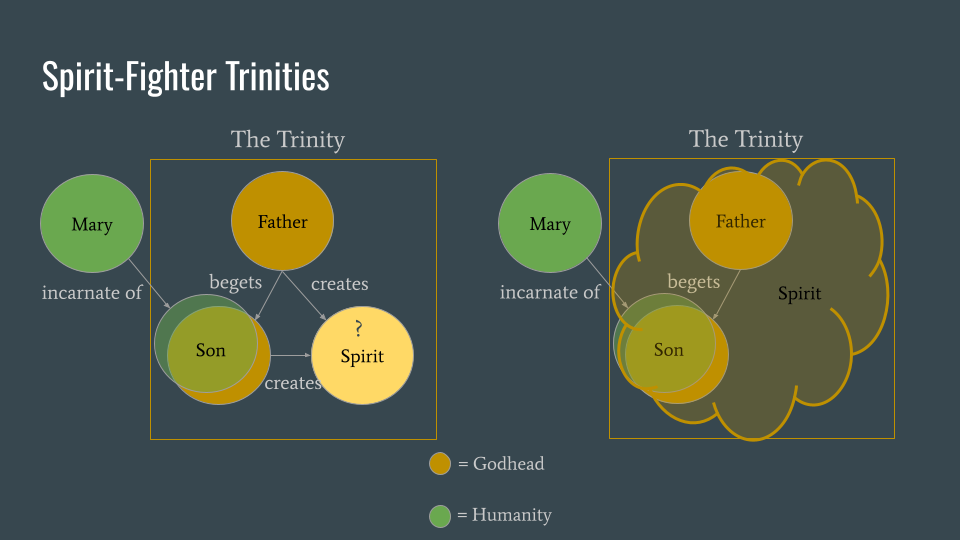
So these are examples of Trinities according to the Spirit Fighters. The first group that held the Spirit to be a lesser created yet still divine being basically worshipped the Father and Son alone, while holding the Spirit to be this lesser being that dwells in us to allow us to commune with the other two. The second group that held the Spirit to be this impersonal force were basically binitarian vs. trinitarian, and the Spirit is literally just the presence of the Father and the Son dwelling in us, and not its own person at all.
Spirit Fighter Arguments
And the Spirit Fighters were actually hard to argue against, even for philosophical and theological geniuses like the Cappadocian Fathers. Because, as it turns out, arguing that the Spirit is equal to the Father and the Son from Scripture alone is pretty difficult. For example, the Nicenes would argue that the Holy Spirit does things in the Bible that only God does, like divine revelation, miracles, forgiving sins, being mentioned alongside God. But the problem is, for every single one of those attributes, you can find another example in the Bible of God giving a created being that attribute as well. Such as prophets, angels, apostles, and so on. Nicenes might argue that the Holy Spirit is listed in Trinitarian formulas, such as “baptize and make disciples in the name of the Father, and the Son, and the Holy Spirit”, right in Matthew, right? But here’s the problem with THAT one. There are formulas in the Bible, that list the Father, the Son, and then X, where X is something other than the Holy Spirit. For example, 1 Timothy 5:21 says “In the presence of God and of Christ Jesus and of the elect angels, I warn you…”. So you might argue, why do we accept some of the formulas as Trinitarian, but not others? Why do we accept the verses that list the Holy Spirit as indicative of his divinity, but then not the other verses when it comes to angels? Okay, finally, certain books like John seem to portray the Holy Spirit as a person. E.g. the Spirit is the helper, he blows where he wills, etc. But in these cases, the Spirit Fighters would appeal to the majority of Scripture that doesn’t portray the Holy Spirit as a person, and chalk the rest up to metaphor or personification.
The Insufficiency of Scripture Regarding the Spirit?
So this is going to be the controversial slide. However…this really is the historical thought process that the Cappadocian Fathers went through, and so I need to present it accurately. The overall problem is that a face value reading of Scripture seems insufficient to prove the full divinity of the Holy Spirit. Let me read from Hanson: “Basil is, however, troubled by his realization that it is impossible to find in the Bible full and wholly adequate support for the doctrine that the Holy Spirit is a separate hypostasis within the Godhead comparable to the hypostasis of the Son. The Cappadocians had enough understanding of the Bible to realize that even the very loose and subjective methods of interpretation employed by almost everybody in the fourth century could not derive any and every doctrine from the pages of Scripture.” Nonetheless, the tradition of theosis strongly motivated the Cappadocian Fathers to uphold the divinity of the Holy Spirit.
The Cappadocian Fathers on Tradition
So. How did the Cappadocian Fathers handle this challenge? Well, they appeal to tradition apart from Scripture as the proof to the Holy Spirit’s divinity. I will just read their thoughts verbatim. So Basil of Caesarea in his work, “On the Holy Spirit”, says the following: “Of the beliefs and practices whether generally accepted or publicly enjoined which are preserved in the Church some we possess derived from written teaching; others we have received delivered to us in a mystery by the tradition of the apostles; and both of these in relation to true religion have the same force.” Okay. Now, Gregory of Nazianzen. “The Old [Testament] openly proclaimed the Father, but the Son mistily. The New [Testament] manifested the Son, but sketched the Godhead of the Spirit. The Spirit is now resident and active among us supplying a clearer manifestation of himself…You perceive periods of illumination gradually enlightening us and an order of revelation which it is better for us to preserve, neither appearing in a single burst nor maintaining secrecy to the very end.” And then Nazianzen also appeals to John 16:12, where Jesus says “I still have many things to say to you, but you cannot bear them now. When the Spirit of truth comes, he will guide you into all the truth.” So basically, he’s saying that the Old Testament is to the New Testament, as the New Testament is to the life and tradition of the Church. And that the Holy Spirit is active in the life and tradition of the Church to reveal doctrines that are not directly clear in Scripture. Almost like the traditions of the Church are themselves a third testament of Scripture. So even though Scripture doesn’t worship the Holy Spirit, the Church tradition of the first four centuries certainly did. For example, and this is the case Basil explicitly refers to, a central part of the liturgy was saying “Glory be to the Father, with the Son, with the Holy Spirit”. And the very prayer I started this presentation with says that as well: “Glory be to the Father, and to the Son, and to the Holy Spirit, as it was in the beginning, is now, and ever shall be, world without end.” So even though Scripture does not worship the Holy Spirit or call it uncreated, the Church had kind of organically done it on its own just through the development of its own worship. And the Cappadocian Fathers basically say that the cause of this tradition is the Holy Spirit working in the hearts of everyday believers and basically pointing everyone in the same direction. And in fact, the Cappadocians were pretty successful in using tradition to support the Spirit’s divinity, because to be fair most Christians already practiced this anyway.
The Cappadocian Trinity
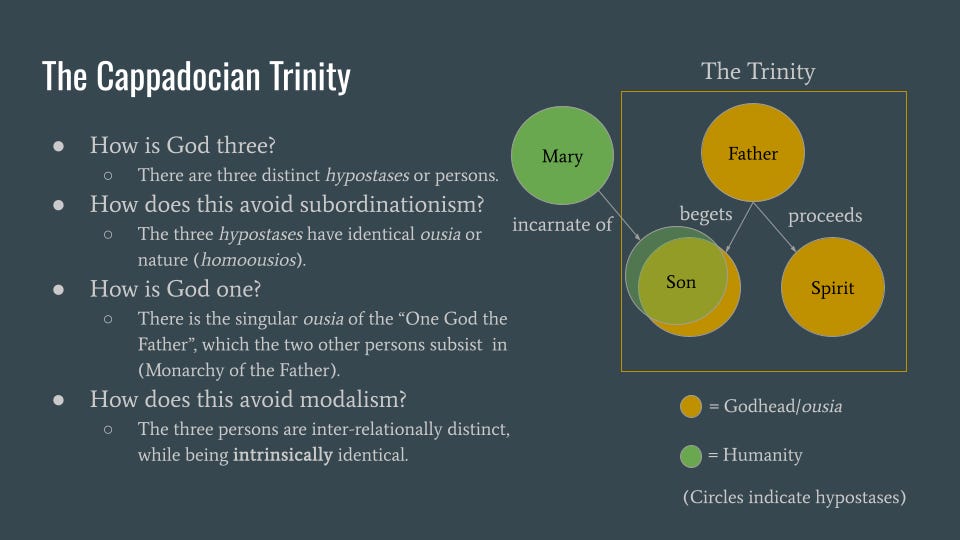
So now let’s look at the final Trinity, which is the Cappadocian Trinity. We see finally the full picture we are familiar with today. We have three consubstantial persons, all possessing the Godhead, all originate from the Father. And the Son also assumes humanity from Mary. And we can see how this model resolves the fundamental confusion of whether God is three or one. How is God three? God is three because there are three distinct hypostases or persons of the Godhead. How does this avoid subordinationism? Because all three hypostases have identical ousia or nature. None is intrinsically superior to the others. So then how is God one? Because there is one God the Father, who eternally communicates his own divine Godhead to two other persons, the Son and the Holy Spirit. Basil used an analogy of like a king, and a statue of the king. Just because you have the king, and then the king’s image in something else, doesn’t mean you suddenly have two kings. It’s the same with God the Father and the communication of the Godhead. But to be clear, the analogy breaks down because a statue of a king is ontologically inferior to the king itself. In the Trinity, all three persons are equal. Finally, how does this avoid modalism? Because to avoid modalism, you need to point to some way in which the three persons are distinct from one another. And the Cappadocians said, yes you can clearly say they are distinct, not through their internal nature, but through their inter-relationships. So even though all three persons are identical, you can still point to differences between the persons in terms of their relation of origin. You can say, “oh, the unoriginate person”. That’s God the Father. Or, “oh, the begotten person”. That’s God the Son. Or “oh, the one who proceeds.” That’s the Holy Spirit. So for the first time in history, the Cappadocians are able to logically explain how God can be three and one at the same time, while avoiding both Arianism and modalism. Which is an astounding achievement and really lets the doctrine of the Trinity click in place for a lot of people and gain acceptance.
Cappadocian Cosmology
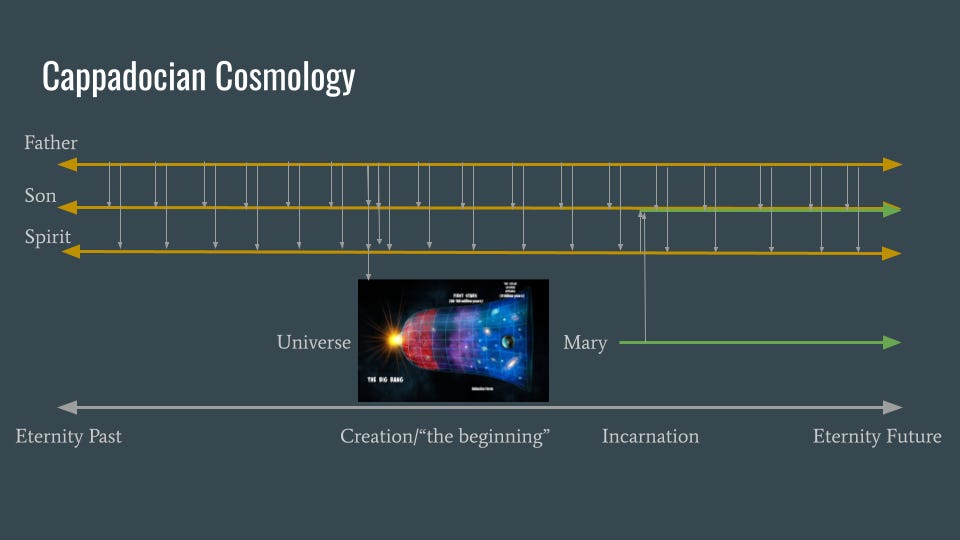
And of course, finally we have the cosmological timeline that we are familiar with today. All three persons of the Godhead existing in perfect relational love for all eternity, originating from the Father, participating in all creative and redemptive actions together.
The Road to Church Unity
Okay so now we’re in the home stretch! Okay so from 373 to 378 AD, the Cappadocians are actually able to drive some consensus on the Son’s divinity in the Church. Just through talking with people, their formula of one ousia and three hypostases just lets people get on board with Nicene theology. However at the Nth hour the Spirit Fighters raise the issue of the Holy Spirit’s divinity. Now in 378, Valens, the Arian emperor, dies in battle and is succeeded by Theodosius who happens to be a pro-Nicene. Then unfortunately, in 379 Basil dies at the age of only 49 years old, having struggled with health difficulties his entire life. So the two Gregories now continue his work. Gregory Nazianzen actually starts a “schismatic” Nicene house church in the mostly Semi-Arian Constantinople. So ironically this is actually the same crime that Arius first committed in Alexandria at the beginning of this conflict. But now Nazianzen is playing an uno reverse and now creating a schismatic church, but this time against the Semi-Arians. And through public sermons in Constantinople he’s actually able to convince many people in Constantinople to become Nicene. In 380 AD, Theodosius declares Nicene Christianity to be the official theology of the empire, and makes Nazianzen the bishop of Constantinople, displacing the Semi-Arian bishop. So basically, Gregory’s church which had been “schismatic” now becomes the dominant church. And finally, at long last, Theodosius convenes the Council of Constantinople, which would produce the Nicene Creed that we know today. So I know this is a deep cut, but for anyone who watched the second part of Death Note, “Separately, neither of us could equal Athanasius. But together, the three of us can surpass the greatest Father ever to live.” So this is like Gregory of Nyssa, or Near, talking about Athanasius, or L. Okay.
The Council of Constantinople (381)
So already just by public and ecclesial discourse the Cappadocians had succeeded in practically unifying the empire around Nicaea. So therefore the council of Constantinople ran smoothly and all were of one mind, right? Well, not exactly…
So 150 bishops, again mainly from the East, met at Constantinople with Nazianzen presiding over the council. However, the city was pretty rife with gossip and dissent. There’s this hilarious quote from Gregory of Nyssa I had to include: “If you ask for change, the man launches into a theological discussion about begotten and unbegotten; if you enquire about the price of bread, the answer is given that the Father is greater and the Son subordinate; if you remark that the bath is nice the man pronounces that the Son is from non-existence”. So a lot of these chaotic discussions are going about all throughout the city. And unfortunately the meetings themselves were dominated by Church politics and territorial disputes, and not the significant theological issues at hand. In the words of Nazianzen: “I finished my speech; but they squawked in every direction, a flock of jackdaws combining together, a rabble of adolescents, a gang of youths, a whirlwind raising dust under the pressure of air currents, people to whom nobody who was mature either in the fear of God or in years would pay any attention…”. So halfway through the council, Nazianzen actually just straight up ragequits and resigns both as president of the council and bishop of Constantinople. And he returns home. So then this hilarious thing happens where they literally pick this random guy Nectarius, who is basically a layperson bystander off the street, and say, “you! You be the bishop of Constantinople!” And he’s very quickly ordained and put in charge. And as Hanson says, “Till Warren Harding was elected President of the United States in 1920, few people can have been less qualified for greatness suddenly thrust upon them.” To be fair he actually ended up doing a pretty decent job and he’s venerated today as a saint in the Eastern Orthodox church. And his name is signed at the top of the Council of Constantinople.
The Nicene-Constantinople Creed of 381
We believe in one God the Father Almighty, maker of heaven and earth and of all things visible and invisible;
And in one Lord Jesus Christ the Son of God, the Only-begotten, begotten by his Father before all ages, Light from Light, true God from true God, begotten not made, consubstantial (homoousios) with the Father, through whom all things came into existence, who for us men and for our salvation came down from the heavens and became incarnate by the Holy Spirit and the Virgin Mary and became a man, and was crucified for us under Pontius Pilate and suffered and was buried and rose again on the third day in accordance with the Scriptures and ascended into the heavens and is seated at the right hand of the Father and will come again with glory to judge the living and the dead, and there will be no end to his kingdom;
And in the Holy Spirit, the Lord and Life-giver, who proceeds from the Father, who is worshipped and glorified together with the Father and the Son, who spoke by the prophets;
And in one holy, catholic and apostolic Church; We confess one baptism for the forgiveness of sins. We wait for the resurrection of the dead and the life of the coming age. Amen.
…those…who allege that the Son of God is of another hypostasis…these the Catholic and Apostolic Church condemns.…Every heresy is to be anathematised and in particular that of the Eunomians or Anomoeans, that of the Arians or Eudoxians (forms of Arianism), that of the Semi-Arians or Pneumatomachi (Spirit Fighters), that of the Sabellians, that of the Marcellians (forms of Modalism)...
So the actual events of the Council of Constantinople were not all that significant, and somewhat chaotic. But that’s okay, because most of the consensus around Nicaea had already been developed in the years building up to this point. And sometime during the two months of the Council, they produce this creed that we say today. Again I’ll go over the exact wording in another video. But the most important part is that the word consubstantial or homoousios reappears to describe the Son. And we have the exact doctrine of the Spirit fully fleshed out: “who proceeds from the Father, who is worshipped and glorified together with the Father and the Son”. So making the Holy Spirit equal to the Father and the Son. Then we can see they deleted the section where they anathemize those who say God is more than one hypostasis, because in fact the Cappadocians relied on the Godhead being in three hypostases. And finally, in one of the canons of the Creed they anathemize a long list of heresies, which includes all the three other camps of the Christology Wars. So they anathemize Arians, Semi-Arians, Spirit-Fighters, and Modalists.
Unity in the Church (For Now)
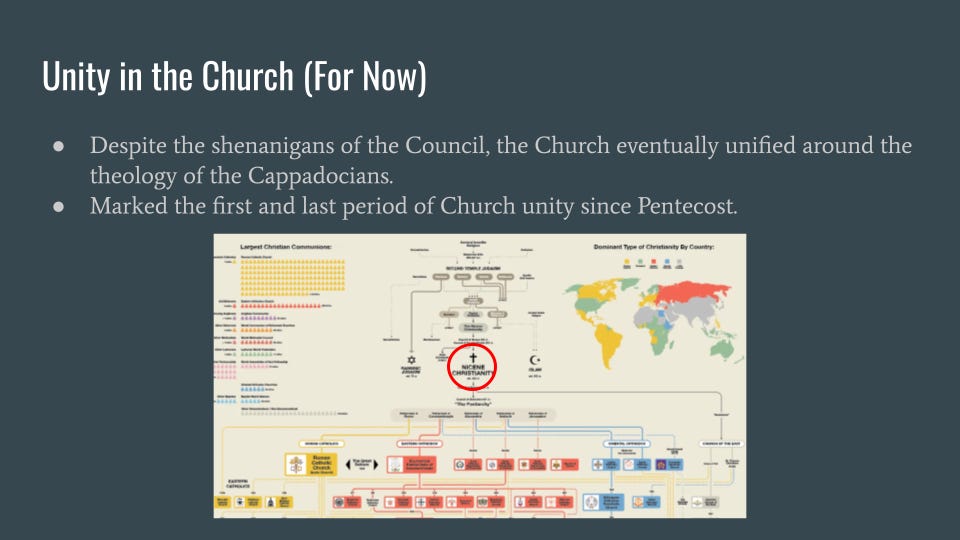
So finally, at long last, we have unity in the Church. And when you look at the context of history, this was an absolutely astonishing achievement. Because if there’s anything the Church likes to be, it is divided. In fact I would submit that this period of time between the 4th and 5th centuries was the first, and last period of true Church unity since Pentecost. Because if you look at a chart of Church history, we can see that initially Christianity was unified in Jewish Christianity, but then quickly split into competing groups which fought until the fourth century, and as we known the Pre-Nicene group itself was divisively split on the issue of Christology. But then at 381, we have this beautiful, unified, one single form of Christianity that is the basis of everything we believe in.
Reflections on Nicaea: Denominational Tensions
Okay, this is the slide where I’m going to make everyone angry. But I mean, I just want to be accurate to the historical facts as far as I can tell. And in the name of “objectivity”, I will do my best to make every tradition equally angry with me. So first of all, the development of the Nicene Creed creates some tensions with Protestantism. In general, most Protestants do hold the Nicene Creed to be dogmatically true as a distinctive Christian belief. The problem is, Protestants also believe in sola scriptura and the sufficiency of Scripture. But frankly speaking, the Nicene Creed does not necessarily seem to follow from Scripture. For one thing, the entire controversy occurred exactly because Scripture seems to be ambiguous in some areas and might not have one clear or “best” interpretation. But even more than that, we know the Creed doesn’t follow from Scripture alone, because the people who made it said it didn’t! The people who made the Creed, said it didn’t follow from Scripture alone! For the doctrine of the Holy Spirit, the Cappadocian Fathers explicitly said it needed to be proven through the traditions of the Church, apart from Scripture. And in the bigger picture, the entire Nicene Creed was motivated by this theological framework of theosis that isn’t clearly in Scripture, and isn’t widely emphasized in Western Christianity today. So I think Protestants have a tension whereby they might not have a basis to accept the Nicene Creed as authoritative, if they also want to hold to the sufficiency of Scripture. Okay, now Catholicism and Orthodoxy are not off the hook either. In my understanding, Catholicism really emphasizes magisterial authority revolving around the Pope of Rome, and Canon law, as the sort of almost legal framework that authoritatively proves doctrine. However, in the fourth century conflict, none of this was helpful towards eventually determining the Nicene Creed! The Pope of Rome certainly played no significant part in the theological development of either of the councils. But beyond that, the proper legal and ecclesial rules regarding bishops and authority and territory were routinely broken by both sides whenever it suited them. The emperors often directly intervened and replaced bishops however they liked, which I don’t think according to the laws of the Church they’re even supposed to be able to do. For Athanasius, even though he was repeatedly condemned and excommunicated by the vast majority of bishops in the Empire, he felt no obligation whatsoever to submit to the rulings of the Church. Athanasius also played political games trying to pit bishops from different territories against each other, and frequently tried to overstep territorial authority when it was convenient to him. And like look at what happened right before the council of Constantinople. Gregory Nazianzen took it upon himself to set up a schismatic church in Constantinople, a city where he had no authority, and openly rebelled against the properly appointed Semi-Arian bishop of that city. Which is the same “sin” that Arius originally committed in Alexandria, but on the opposite side. So even though none of this is, like, a concrete contradiction with Catholicism, the process as a whole to get to the Nicene Creed looks very non-Catholic, at least to me. And then also, just the fact that the original Creed did not have the Filioque clause, and that the Holy Spirit only proceeded from the Father alone, not the Son, is very significant. Okay, now Eastern Orthodoxy also has problems with it. Yes, the beloved Eastern Orthodoxy is not off the hook. Actually, if any Eastern Orthodox are watching this video you’re probably angry at me for pointing out Athanasius’ character flaws, and not treating him very reverently. And not being very reverent as to the proceedings of the councils. Okay, look, for all the Orthodox watching, I’m very sorry, but I’m just trying to be historically accurate. The biggest problem with Orthodoxy revealed in this conflict is that Nicene theology was not mainstream or a widely held tradition before the fourth century, but itself was a development. Because Orthodoxy basically prides itself as the only branch of Christianity to hold properly to the original Apostolic traditions without any loss or innovation. But historically, this was simply not the case here. Theology needed to evolve, adapt in new ways, and incorporate new ways of thinking, to finally do away with the idea that the Son is subordinate to the Father. And I think a really big tension in Eastern Orthodoxy is that the denomination just doesn’t have much self-awareness or a formal mechanism to allow for the fundamental development of doctrine. They basically need to dogmatically assert that everything they believe today was believed since the apostles in some form, which is not provable from history. But anyways, I just wanted to go through this slide, because I think it’s interesting that, retrospectively, the actual historical facts of Nicaea does create some tensions with every tradition today.
Alright, well thank you so much for watching! If you’ve made it this far, thank you so much! You’re a champ! Please hit all the buttons below that help me, please like and subscribe, and leave a comment telling me your thoughts. I’d love to hear your feedback, either positive or negative. Because I really value constructive debate, because this is the only way to grow, is to be in dialogue with people you disagree with. Anyways, I hope this presentation of Nicaea was informative and edifying to you, and I wish you peace in the name of the Triune God! God bless, and hope to see you at my next video!


