

Glory be to the Father, and to the son, and the Holy Spirit, as it was in the beginning, is now, and ever shall be, world without end, amen. Today we will dive into what that confession actually means, and hopefully we will be able to describe the Trinity more accurately than Saint Patrick did. In this first presentation on what the Nicene Creed means, I will cover the history of the Arian Controversy from 318-381 AD, and the background context of how we got the final creed the Church uses today. In a separate presentation, I will go through the Nicene Creed line-by-line and explain what it means in detail.
Disclaimer
So first, some disclaimers! I am a layperson; not a historian or theologian! So feel free to take everything I say with a grain of salt and fact check me. For my personal bias, I am a self-described “non-Orthodox with Eastern Orthodox leanings”, but I do my best to be “objective”. So do with that as you will. Now, most of the content is from the book The Search for the Christian Doctrine of God by RPC Hanson (1988). When I was looking up books to read on Nicaea, I picked this book because it seems to be considered very reputable and the foundation for modern historical analysis on the Arian Controversy and Nicaea. And according to SciSpace it is still the most cited work on the Arian controversy. Information on early Christianity from 30-300 AD is from Lost Christianities by Bart Ehrman. Now since I’m trying to move fast, some generalizations are made for the sake of time. Hopefully I can point these out when I make them. Finally, quoted scriptures are from the NRSV Updated Edition, which is the most recent modern critical scholarly translation of the Bible.
Introduction
So let’s begin by introducing Nicaea. According to Pew Research, more than 95% of Christians profess the Nicene Creed, and its doctrine of the Trinity. Christian groups who don’t profess the Nicene Creed include Mormons, Unitarians, probably some sects of Protestantism, etc. In fact, many Christians consider the Nicene Creed the dividing line of what makes someone a Christian or not, so arguably 100% of Christians profess the Nicene Creed! Now, it is my opinion that Nicene Trinitarian theology is very beautiful and elegant, and I hope that this presentation will help you understand and appreciate it. However, as we will see, the process to get to the Nicene Creed was not all that beautiful and elegant, and was often chaotic, circuitous, and confusing. And often it looked like the Arians were going to win! So really, my takeaway is that the process to develop Nicaea is a story of God’s providence against human wisdom and all odds! Because it really is crazy and providential that we were able to land on the theology we did. And so that’s why I think it’s important to just keep in mind the ultimate basis of our faith, which is the resurrection. He is Risen! We know that the apostles witnessed the resurrection, spent their whole lives proclaiming Christ, and died for their beliefs. Because of their testimony, we know that Jesus is Lord, and that we can trust in his promise to guide His Church with the Holy Spirit. As John 16:13, “When the Spirit of truth comes, he will guide you into all the truth”. And 1 Timothy 3:15 calls the Church “the pillar and bulwark of the truth”. Because we know Jesus is God, and he sent his Holy Spirit, we can trust that the Nicene Creed, which has basically been accepted by every Christian over the last 1700 years, is true and guided by the Holy Spirit.
Why Start With History?
So why start with history? The Nicene Creed is not merely a statement of belief. It was intentionally written to be the boundary separating Christianity from non-Christianity. And this is only clearly apparent when you understand the full historical context, and the exact beliefs it was trying to fight against. What the Creed does not say is just as (or more) important than what it does say. And also these historical heresies continue to reappear in various forms today. As the saying goes, to be ignorant of history is to be doomed to repeat it. By better understanding the historical heresies, we can be on our guard to avoid them when they reappear in our lives today. Finally, I think it’s so important to understand the exact process by which the creed developed from 318-381 AD, because it is such a vivid demonstration of God’s providence through the Church. So when our world seems chaotic today and God’s presence seems hard to find, we can have the assurance and the understanding that God is using circumstances for his overall plan, and we are a part of that.
Addressing Common Misconceptions About Nicaea
So first I want to address some common misconceptions I often hear about Nicaea. People often say that the council of Nicaea determined the canon of scripture, which is completely untrue. In reality, there was no church-wide council that ever determined the canon of scripture. The canon actually just organically developed over time as all Christians more or less just accepted the same books of the Bible. That’s a story for another time. But actually all sides of the dispute more or less agreed on around 20 of the core books of the NT. And the more controversial books, like Revelations, didn’t really play a core role in the dispute. So it wasn’t like the Nicenes accepted one book of the Bible and the Arians didn’t. In reality, all sides agreed on what scripture was, the dispute was the interpretation of scripture. Secondly, I often hear that the Arians believed that Jesus wasn’t God, and that we had to have Nicaea to prove that Jesus in fact was God. This isn’t true. All parties already agreed that Jesus was “God”. The dispute was in what way Jesus was God. And we’ll see more of this in the presentation, because saying more than one thing is God can mean different things to different people, especially in antiquity. Next, we often hear this story that once Nicaea met in 325, everything was resolved and everyone knew for sure what the correct doctrine of the Trinity was. In reality this was not true. Nicaea actually raised more questions than answers, and the dispute raged on for more than 50 years until the council of Constantinople in 381 was able to bring more consensus, and produce the Nicene creed used today. Finally, one misconception I want to correct is this idea that the exact doctrine of the Trinity was always known since the apostles, and then Arianism came along and was this crazy heresy that distorted it, until Nicaea was able to correct the Church back to the original view. In reality, Orthodoxy was not widely agreed upon before the 4th century, and for 300 years a diversity of views of the exact divinity of Jesus existed side by side, and the specific formulation of Nicaea did not exist and was not finalized. So Nicaea was as much a development as Arianism was. This will become more clear in the presentation. There’s this really important RPC Hanson quote I want to highlight, which is “Orthodoxy on the subject of the Christian doctrine of God did not exist at first. The story is the story of how orthodoxy was reached, found, not of how it was maintained”.
Christology Wars: The Prequels (30-300 AD)
So before diving into Nicaea, let’s rewind the clock and look at the prequels to Christology Wars. That is the first three centuries. What were the range of beliefs that Christians had about Jesus and God?
Why Did the Arian Controversy Not Arise Until the 4th Century?
And why did the Arian Controversy not arise until the 4th century? Why did it take so long for the exact issues of Jesus’ divinity to be fully worked out? Well, one reason is that, in the first three centuries, constant persecution prevented the organizational stability of the Church for debating these nuanced theological issues. If you think about it, if the church has to operate underground, and can’t hold public debates or publish theological treatises, and the leading bishops and theologians can just be arbitrarily killed by the authorities, this isn’t very conducive for being able to work out theological details. The focus is more on the raw basics of the gospel and survival. Which, you know, has some pros but it also has some cons. But in addition, in the first three centuries, “proto-orthodoxy” faced larger threats from other branches of Christianity than from within. Notice that I’m calling it “proto-orthodoxy”, which is a term many scholars use to talk about the branch of Christianity from the first three centuries that was the predecessor for the Christianity we follow today. In reality, proto-orthodoxy was not the only or even the most dominant form of Christianity in the first three centuries, depending on the specific time and place. There were at least two other branches, Jewish Christianity, and Gnosticism. And it’s not like at the time, proto-orthodoxy was necessarily the obvious “correct” branch. We only really know this from retrospect, since it’s the only branch that survived to be passed down today. And these branches had vastly different understandings of Jesus and God, so that the proto-orthodox were more focused on correcting the major errors of these other branches, instead of internally arguing about details in their own camp. So very broadly speaking, and this is one of the times I’m making broad generalizations, Jewish Christianity believed that there is one God, and that Jesus is not that God but an exalted human. Proto-Orthodoxy of course believed that there is One God and Jesus is that God. And Gnosticism believed that there were two Gods, a good and an evil God, and that Jesus is the good God. So each of these branches had their own churches, traditions, and scriptures, and recent archaeology has found that the non-orthodox branches were more widespread than previously thought. So it’s fortunate that proto-Orthodoxy is the one that survived and turned out to be correct, which I think we can assume is the work of the Holy Spirit.
What Did Jewish Christians Believe?
So let’s dive into these heretical branches, starting with Jewish Christianity. To start with, Jewish Christianity believed that Paul was a false apostle. And to kind of get into their head and stand in their shoes, it kind of makes sense why they would think that. After all, Paul was someone who converted to Christianity years after the original 12 disciples, and he actually never met Jesus personally. So it kind of makes sense why some people would be suspicious of Paul, especially since he strangely had the most radical teaching in terms of allowing uncircumcised Gentiles to join the Church. Imagine how differently Christianity would look if you took out Paul. First of all you’d need to get rid of a lot of books of the NT, as well as rewrite some of the gospels which are written by authors who were influenced by Paul. So Jewish Christians believed that the OT Law (Torah) continued to be the boundary for God’s covenant. As Psalm 111:9 says, “he has commanded his covenant forever”, and there are a lot of other verses in the Old Testament about God’s law remaining forever, about circumcision being an everlasting covenant, and so on. So the Jewish Christians were on strong scriptural standing here. So naturally, they believed Jesus was the human messiah predicted in the Old Testament, and that Jesus himself, as a Jew, upheld the mosaic law in his teachings. After all, he said things like “Do not think that I have come to abolish the law”, “not one iota of the law will pass away”, and so on. As all Christians did, Jewish Christians believed Jesus had died, resurrected, and would one day return to judge the world. So the interesting thing is that Jewish Christianity in some form was the earliest Christian denomination, and gentile Christianity really took off later in the first century in large part due to the apostle Paul and the council of Jerusalem. Even then, Jewish Christianity was still very significant for the rest of the first century, and we have texts in the Bible itself kind of describing the tensions between Jewish and Gentile Christians, such as Paul’s letter to the Galatians. And they continued to be a presence until the 4th century, though they eventually faded into obscurity. So even though Jewish Christianity didn’t directly survive until today, I think the underlying heresy still has overarching themes that continue to appear to us. The main problem with Jewish Christianity is that it raises unnecessary barriers for believers joining the Church that God himself no longer imposes. This is basically what Paul calls “justification” in Galatians, which is the outward proclamation of one’s internal status before God. And the only thing we should really use to outwardly determine who is in the community of the Church is faith in Christ Jesus, and not anything unnecessary. And I suggest we think about what ways we add unnecessary barriers today to who is part of the Church. Do we only accept people who look similar to us, who talk and behave similarly to us? Do we only reach out to people with the same political beliefs as us? I know there are many churches in America that say you need to vote Republican if you’re truly a Christian. But that’s completely against what Paul says in Galatians. I think political beliefs shouldn’t be a barrier for who is in the Church or not. For me personally, I confess that I’ve struggled welcoming people in different age groups or life stages from me, but that’s really wrong because the Church is supposed to be welcoming of the entire diverse body of Christ, from all walks of life and situations. So yeah, for this particular heresy, think about ways we put up invisible barriers within the body of Christ. I do want to say, I think the New Perspective on Paul has basically done away with the outdated caricature that Jewish Christians were legalistic, and that the problem is they tried too hard or followed too many rules to get to God. That’s just not an accurate view of second temple Judaism or Jewish Christianity. Jewish Christians definitely showed great effort in living out their faith, but in the words of John Mark Comer, God isn’t opposed to effort, he’s opposed to earning. Having rules of life and faith are not bad things if these are things that the Spirit has led the church into as practices that give medicinal value to our spiritual lives. But they are bad if they themselves become the barriers gating membership to the Church, and they’re also bad if they are not things instituted by the Spirit at all, like cultural or political or demographic barriers. And that’s the issue we need to address with this particular heresy.
What Did Gnostics Believe?
Now, gnostic Christianity is interesting. It basically believed that the physical universe was created by an evil God, and therefore the world is sinful and fallen. Gnostics believed that the God of the Old Testament is evil, after all he’s often portrayed as wrathful, jealous, angry, and often commanding very questionable things such as the Canaanite conquests, very strict punishments for laws and not keeping the Sabbath, etc. On the other hand, there is a good God who appears in the New Testament who is compassionate and merciful and loving, who has sent Jesus in order to save us by his secret teachings. Jesus was a fully divine being without a physical body, because physical bodies are bad, and he only pretended to be human. And through Jesus’ secret teachings (gnosis), our souls can be liberated from our fallen physical bodies. Similar to proto-Orthodox Christianity, Gnosticism started to pick up in the second half of the first century, and we see certain parts of the New Testament like John and Paul’s letters trying to counter various Gnostic beliefs. Gnosticism was probably the biggest threat to proto-Orthodox Christianity because recent historical evidence has shown that there were actually parts of the world, such as Egypt, where Gnostics actually outnumbered proto-Orthodox Christians for some periods of time. Its dominance probably peaked in the 2nd and 3rd centuries but then eventually by the 4th century it was on the decline and not very relevant. And no branches of gnostic Christianity survived continuously to today. Nonetheless, we can still ask, what is the core spirit of this heresy that still reappears in our lives today? I would say the biggest problem with Gnosticism is that it really just degrades our physical and holistic nature, and focuses completely on the mind and knowledge. In reality, God created the world and our bodies to be good and to worship him. Being in a body is a good thing, cuz afterall Jesus came as a physical flesh and blood human to redeem our bodies. One thing to note is Gnostics were actually known for being very promiscuous and hedonistic, because they felt that as long as they had the saving secret knowledge, what they did with their bodies didn’t matter. That sounds a lot like the emphasis our culture has put on having a “saving knowledge” of Jesus, while often many nominal Christians don’t change their behavior or feel a need to stop sinning in their every day lives. Another way I’ve often seen Gnosticism play out in churches today is a shift towards very heady, sermon-heavy services that have a lot of teaching, but not very much worship, and certainly not very much fully embodied worship. If you ever have the chance to visit an Orthodox or a Catholic church, there are parts of the service where they are literally bowing, prostrating themselves, positioning themselves towards different parts of the room as the liturgy requires. And these more traditional churches try to create a fully holistic experience relating to all five senses; for example, smell, they will light candles and incense. Sight, they very intentionally beautify different parts of the church with artwork intended to instill reverence and awe. Taste, is obviously intentionally, well prepared, high quality wine and bread for communion. After all, the verse is “taste and see that the Lord is good”, and the Eucharist is supposed to be a celebration. So in my personal experience, fully embodied worship of the five senses is really what we are created to do in a church context. And to be fair, there are ways in which certain Protestant and non-denominational churches have been realizing how to return to this in recent years. But maybe you want to apply this outside of Sunday morning worship and consider whether you are dutiful in your everyday life to serve God with your entire body. One thing I think about is mental and emotional health. God created our mind and emotions as good things to be experienced and then used to worship him, but so often we shove mental and emotional wellbeing to the side for the sake of higher productivity and the daily grind. And that’s not really the only thing we were created to do. So I think having a high degree of awareness of your entire body and psychology, and how your overall wellbeing is either being blessed or is in need of God, and then turning that around in worship, is very important to do. Personally, these are things I only really started being aware of in the last few years, and once I did I realized the reason why I often seemed to be stuck in so many spiritual ruts often had to do with my physical and mental rhythms. So I would encourage you to think about how Gnosticism could be affecting you today, because I really think the modern church in America often suffers from this. Maybe one thing to also think about is whether your faith is all head-knowledge based, or if it actually expresses into your embodied existence, and changes your behavior and interactions with others. Finally, another notable thing about Gnosticism is how it denied the goodness of the Old Testament God, which I got to say does carry over to Christianity today. More often than not, we find the New Testament very relatable and exciting, but we just see the Old Testament as some dusty old, hard to understand books that don’t impact our faith all that much. But remember, 75% of the Bible is the Old Testament, which means all the crucial information for understanding God, the same God of Jesus and the entire Bible, has to come from the Old Testament. So yeah, maybe think about whether Gnosticism still impacts us today in terms of our preference to skip reading the Old Testament.
Why Was Proto-Orthodoxy “Victorious” by 300 AD?
So out of all these branches of Christianity, why was proto-orthodoxy victorious by 300 AD? Because by about 300 AD, proto-orthodoxy was the main relevant branch still remaining and the others were on the decline. Well, for Jewish Christianity, it just turned out that Mosaic Law was too great a burden for most Gentiles to accept. It’s very hard to get circumcised, not work on the sabbath, not eat certain foods, etc. Now for proto-orthodoxy, our ancestors, they were basically able to organize themselves into a global network of bishops, strongly structuring the faith. Now when I’ve heard this topic covered before in the past, I’ve noticed some protestants ask “bishops? Like Catholic bishops?” Well back then, all churches were under the governance of bishops. In fact, bishops are a term in the Bible, such as 1 Timothy 3:2, “Now a bishop must be above reproach…”. It’s the same word in the Greek for bishop, or episkopos. And universally across the board, all proto-Orthodox churches accepted a system where all churches in the city were governed by a singular bishop, who basically had sole teaching authority, could excommunicate members, could appoint or depose priests and deacons, etc. So this was a very powerful position, but also had an important unifying effect to protect the continuity of the teaching handed down through generations. If you’re ever interested to hear about the rationale of why the system of bishops was developed, you can read Ignatius of Antioch’s letters which explain how the single office of bishop prevents squabbles and minor disputes from tearing the church apart, and also protects from dissident voices and heresies polluting the faith. Now yes, in Evangelical America we would consider bishops to be authoritarian, but back then they were really a necessity and were very effective at their intended function of preserving unity. I also want to point out that it’s not as if bishops had no checks on their power; as we will see later in this presentation, part of the job of bishops was to communicate with other bishops in this global network, and in cases of conflict rebuke or even excommunicate other bishops who have gone astray in hopes of bringing them back to the correct path. Another factor with proto-orthodoxy was that it strongly emphasized perseverance and martyrdom, and the idea that bodily suffering brings sanctification. After all, we serve Jesus who suffered and died for our sanctification, and then told us to take up our own crosses daily. And this is why we have just so many martyrdom accounts from the first few centuries, of Christians holding to their faith even under torture and death. Proto-orthodoxy also strongly discouraged apostasy, for example there are various passages in Hebrews that from a historical perspective basically indicate that denying your faith is an unforgivable sin. And this was a reason why the book of Hebrews remained so controversial for so long. Now the later church tradition that has received Hebrews also said that the book needs to be interpreted such that there is a chance for repentance after apostasy, but this wasn’t the literal reading in the first three centuries. There’s another early Christian text called the Shepherd of Hermas that, similarly, restricted forgiveness for apostasy. On the other hand, gnosticism discouraged the notion of hierarchy, because they felt that no one person has a claim to what the “truth” is, and that anyone in their own minds can access gnosis. But as a result, Gnostic sects failed to gain any true unity, and were often diverse and discordant with each other. So they weren’t able to expand meaningfully. Gnosticism also didn’t value perseverance or martyrdom, because they basically held that bodily suffering is meaningly, because the body is sinful. So a lot of their converts gave up under persecution and weren’t very stable. So because of these factors, which I think the Holy Spirit guided under providence, Proto-Orthodoxy ended up as the mainstream Christianity by the 4th century.
Christology Wars: A New Creed (300-325 AD)
So now this brings us to Nicaea itself. Starting with Christology Wars episode IV, a New Creed.
The Conversion of Constantine (312 AD)
So definitely the most significant event that precipitated the Arian Controversy and the ensuing councils is the conversion of Constantine to Christianity, and the subsequent legalization of Christianity in Rome. So Constantine was the son of the previous emperor who had died, but the succession of power wasn’t clear and Rome was in a period of civil war with multiple people vying for the throne. And Constantine had actually been raised as a pagan. But before going into one of the battles, Constantine suddenly had a vision of a cross in the sky, and the words in Latin, “in this sign, you will conquer”, which is what the image on the left depicts. So Constantine had his men paint a Christian symbol on their shields, which you can see in the image on the right. See how it looks like an X and a P? Well these are the letters Chi and Rho in the Greek alphabet, which are the first two letters of Christ, and this was a common Christian symbol back then. Well Constantine actually ended up winning the battle and becoming emperor, and as a result converted to Christianity and brought the entire empire of Rome with him. And from all accounts, he was genuine in his faith. Like this was an honest vision that he had, which he honestly believed and then spent the rest of his life legitimately trying to foster the growth of Christianity. Now I’ve often heard the legalization of Christianity painted as a bad thing, and as the start of when people began being more lukewarm in their faith. I personally see it as more of a mixed bag. There were definitely many good things that came from the legalization of Christianity. The number of Christians in the Roman Empire jumped from 10% to 50% almost overnight, which is the largest increase in such a short period of all time. I’ve heard some people say that the growth of Christianity slowed down after legalization, but this is misleading. If anything, the growth slowed down because they literally ran out of people to convert. So there was definitely a benefit in terms of spreading the gospel. Now of course the downside was the unfortunate mixture of Church and State, which began now and would never be challenged until the United States and the first amendment in 1791. Obviously, the mixture of Church and State has led to a lot of terrible things in Christian history, many of which we will see in this presentation. But in fact, once in a while the emperor ended up being a good thing for Christianity. As we will see, the emperors could help facilitate Church-wide councils in order to resolve disputes, and could be a real stabilizing force amidst times of conflict. And the emperors, while powerful, were not all-powerful. Even though some emperors tried their hardest to enforce their particular version of Christianity, the Church and the Holy Spirit proved to be very resilient, and the emperors simply could not have lasting success unless most or all of Christians were already on board.
4 Christological Camps in Proto-Orthodoxy
So the explosive growth and legalization of Proto-Orthodox Christianity finally brought attention to the core Christological disputes that had gone unspoken for hundreds of years. There were at least 4 broad camps, again a generalization, that had scriptural support and had traditions stretching back into the first 300 years. And to give a brief high level overview, these were Arianism, which believed Jesus was a lesser divinity created by the Father, Semi-Arianism which believed Jesus was a lesser divinity than the Father without being created, “Orthodoxy” which was that Jesus is an equal divinity to the Father, and Modalism which was that Jesus is an identical divinity to the Father. Now note that “Orthodoxy” is in quotes. It is only with the benefit of hindsight that we can call this party “Orthodox” because it was eventually the group that emerged victorious. However, as we will see at the time it was not all that clear that the idea that Jesus was equal to the Father would receive widespread support in the long term. Now, clearly Arianism was on the radical side of the spectrum in terms of claiming that Jesus was created, which was a doctrine that made all the other groups angry. As RPC Hanson says, “The part of Arius’ doctrine which most shocked and disturbed his contemporaries was his statement that the Father made the Son ‘out of non-existence’”. The “out of non-existence” part is important; I think for hundreds of years many Christians had already had this idea that God produced Jesus out of his own divine nature somehow, and we’ll look at this doctrine more in detail later, but Arius took it a step further by saying that the Father actually produced the Son out of nothing, which basically put the Son on the same level as all other creatures in creation, which were made out of nothing as in the creation story in Genesis. So even though Arianism was just one view amongst many emerging out of proto-Orthodoxy, it attracted the most controversy because of this specific doctrine of the Son’s creation.
Traditional Precedents to (Semi-)Arianism
Now the reason I’m explaining all this is because I want to dispel this notion that I’ve heard that Orthodoxy had been clearly taught in the Church all along, and then Arius suddenly came along in the 4th century out of nowhere and started teaching the Son’s creation. This portrayal is just really inaccurate and strawman’s Arianism. I think whenever you are looking at history and just portray people as complete idiots, radicals, or heretics who were clearly wrong and should have known better, this is just really arrogant and does a disservice both to history and to yourself. The reality is that every viewpoint that has ever developed had its own internal justification and rationale, that made it convincing and caused it to gain followers. And the same is true of Arianism, so in this presentation, I first want to build up Arianism and explain what made it so appealing, before tearing it down and explaining all of its errors. When we do this, we have a much better picture of history, and then we can learn much better and apply the lessons to our own lives, and see how to avoid heresies in our own day no matter how appealing they might be. So when looking at the precedents to Arianism and Semi-Arianism, there were several theologians in the first three centuries who had some conception of the Son being less than the Father or the Son being created. First is Origen, who was by far the biggest and most influential theologian of the early Church. As seen in this quote, he clearly had this idea of the Son being less than the Father, and that while the Father perfectly knows the Son, the Son doesn’t perfectly know the Father, so there is an asymmetry in that way. Dionysius of Alexandria is super explicit, and says the Son is a creature. In fact, there’s this important RPC Hanson quote that “virtually every theologian, East and West, accepted some form of subordinationism at least up to the year 355; subordinationism might indeed, until the denouement of the controversy, have been described as accepted orthodoxy.” So Arianism definitely did not pop out of nowhere, but had firm precedent, so it’s easy to see where it came from.
Arianism Explained
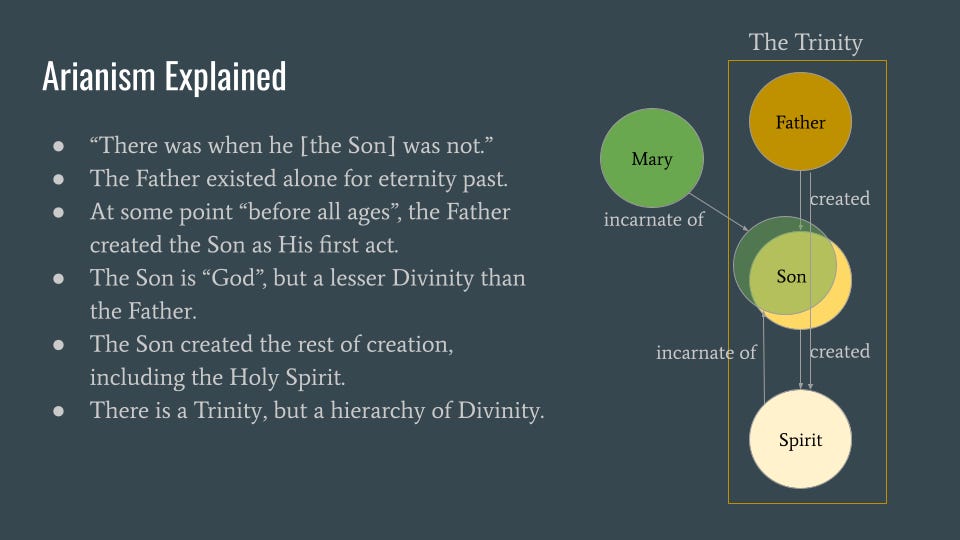
So this is a diagram that explains the Trinity according to Arianism. The famous Arian line is “There was when he was not”, basically calling the Son a created being by the Father. This means for eternity past, God the Father existed alone by himself as a solitary God. Then, at some point “before all ages”, the Father created the Son as His first act. And the Son is “God”, but a lesser Divinity than the Father. And then sometime after that point before all ages, the Son created the rest of creation, including the Holy Spirit. There is still a Trinity, but a hierarchy of Divinity. The different shades of gold basically indicate different degrees of Divinity.
Arian Cosmology
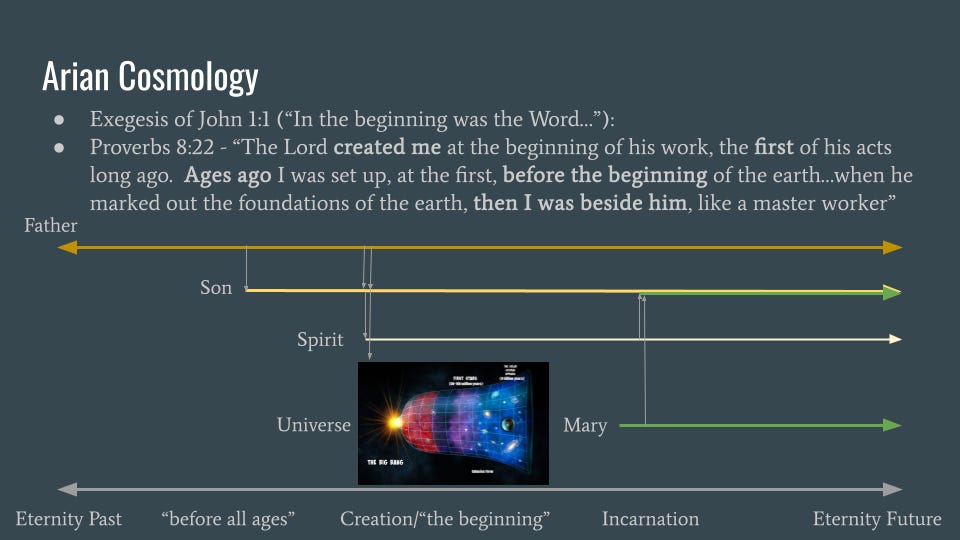
And this timeline basically describes Arianism cosmology. Now the standard verse to counter Arianism is John 1:1, “In the beginning was the Word…”, which means that Jesus, the Word, always existed for eternity past. However, Arians had a way to explain this, rooted in scripture. The key Arian text is Proverbs 8:22. Now Proverbs 8 is describing a personification of Wisdom; however, Christianity has a long tradition of equating Wisdom in Proverbs with Jesus from the New Testament. Because, you know, Jesus is the Word or Logos, and therefore Jesus is Wisdom as well. And yes, this interpretation may seem strange, but realize that all fathers at this period in time all agreed that Proverbs 8:22 is talking about Jesus, and in fact this tradition has continued to modern day in both Catholicism, Orthodoxy, but Protestantism as well. So Proverbs 8:22 says, with the important texts highlighted, “The Lord created me at the beginning of his work, the first of his acts long ago. Ages ago I was set up, at the first, before the beginning of the earth…when he marked out the foundations of the earth, then I was beside him, like a master worker.” So looking on the timeline, this is basically saying that the Father existed alone for all eternity, and then at some point “ages ago” or “before all ages” the Father created the Son. And then after this was the real beginning where the Father and Son work together to make the rest of creation. So this is consistent with John 1:1, because “the beginning” refers to this point when the universe was created, not “before all ages” when the Son was created. Now think about what the implications are of this cosmology. We basically see that the Father alone existed all by himself for eternity past. Think about how dreadful and lonely a God this is. Because eternity literally means eternity. Like it’s a long, long time. Like imagine how long a millisecond is compared to the age of the entire universe. Eternity, is like that but even infinitely bigger. So from God’s POV, the existence of the entire universe is barely a blip in his consciousness, and the vast, vast majority of his experience of existence is just himself, sitting there, alone. Like, think about how terrible that is. Does that feel like a loving or good God? Or is it a depressing, dark, lonely God? Just something to think about.
The Rationale of Arianism
Also, there is a strong philosophical rationale behind Arianism. In Greek metaphysics, God was this holy and infinite and perfect being which simply could not directly interact with our imperfect reality. As this Arian quote goes, “He does not condescend to human contacts nor human flesh”. Aristotle had this thought where the perfect being can only have perfect thoughts and actions, and by definition then all his thoughts and actions have to be about himself, because as soon as he starts thinking about something else in creation then he’s basically not using his mind to only think about perfect things, which then makes him imperfect. So to solve this problem you need a lesser diety who is still divine and perfect and worth acting on, but doesn’t have all the same constraints as the full God in terms of contaminating himself with reality. And so Arians basically thought this lesser diety was Christ, and you know there’s even scriptural support for this in passages that talk about Christ being our only mediator to God. And then this lesser deity could suffer and die for our sins, as this other quote says “Let them answer then how this passable and mortal person could be consubstantial with God who is beyond these things: suffering and death.” So I think even though Arianism is no longer directly around today, there are still aspects of this heresy that sneak in our faith today and impact us. I would ask you to consider this; in what ways do you feel God is too holy and too far removed from you to connect with? Do you ever experience what seems to be a lack of God’s presence, and then deceive yourself that maybe he doesn’t care about you at all? Or maybe you feel like the sins you’ve committed are too great, too despicable, that you’re irredeemable and you can’t bring yourself to face God. I know I’ve definitely felt this at times in my own experience, like I’ve been stuck in the same ruts over and over, and I’m a failure to God and just don’t feel his presence. I think at times like this we hear echoes of the Arian heresy all the way back from the 4th century, reappearing now. But thanks to Nicaea, we know that there’s nothing separating God from directly reaching down into the world and touching our lives. And he desperately desires to and continuously does so.
Duel! Arius vs. Alexander of Alexandria (315-325 AD)
So anyways, let’s do a speed run of the controversial events involving Arius that led to Nicaea. The two main players of the conflict were Arius, a presbyter of Alexandria, and Alexander, the bishop of Alexandria. As we have seen, Arius’ teaching that the Son was created alarmed many in Alexandria. Alexander eventually excommunicates him. However, Arius finds considerable support from other bishops in Egypt and adjoining Palestine. These other bishops urge Alexander to re-admit Arius. Alexander refuses. Arius then sets up a parallel schismatic church in Alexandria. We see at this point the dispute bubble over into the public sphere in the form of public disturbances, brawls, and riots, and lawsuits between different factions of believers. At this point, news of the conflict reaches Emperor Constantine. He unsuccessfully attempts to reconcile Arius and Alexander. Then, other bishops meet at a council in Antioch, Syria, supporting Alexander and condemning Arius and his allies.
The Council of Nicaea (325)
At this point, Constantine calls for a church-wide council in Nicaea. This council is attended by about 300 bishops, mostly from the east but a few from the west, the largest council ever at that time. And these are bishops from all camps of Christianity: Arianism, Semi-Arianism, Orthodoxy, and Modalism. Alexander’s deacon Athanasius is also present. Remember Athanasius, he will later become the main character of this entire saga.
Proceedings of the Council of Nicaea
So let’s take a look at what happened at Nicaea. Going into the council, most bishops expected to compromise with Arianism. You know, because the doctrine of Christ’s divinity had never been concretely settled before this point, and most held some sort of subordinationism. Arius by this point had learned to avoid the “created out of non-existence” rhetoric, and used other phrases like the Son was “established”, “appointed”, etc. Nonetheless, Eusebius of Nicomedia, an Arian, stood up and read a statement: it is absurd to consider the son consubstantial with the Father; instead “from Scripture…we learn that the Son was created…”. As soon as he said the word “created”, most bishops were immediately outraged. He had basically stepped on the third rail. The bishops ripped Eusbius’s papers out of his hand and ripped them up. So at this point, the attitude of the council shifted away from trying to make a compromise, and became decisively anti-Arian. And the interesting thing is, because they wanted to specifically make an anti-Arian creed, and Eusbeius had specifically said he could not tolerate the term homoousios or consubstantial, they decided to put this exact word in the creed. I will explain more about this word homoousios in a bit. But as Ambrose says, “the Fathers placed…the term homoousios in the Statement of Faith, because they saw that it caused alarm to their opponents.” Arius and two bishops refused to sign the creed, and were exiled by Constantine.
The (First) Nicene Creed of 325
We believe in one God, the Father Almighty, Maker of all things, seen and unseen.
And in one Lord Jesus Christ the Son of God, begotten as only-begotten of the Father, that is of the nature (ousia) of the Father, God of God, Light of Light, true God of true God, begotten not made, consubstantial (homoousios) with the Father, through whom all things came into existence, both things in heaven and things on earth; who for us men and for our salvation came down and was incarnate and became man, suffered and rose again the third day, ascended into the heavens, is coming to judge the living and the dead.
And in the Holy Spirit.
But those who say, “there was a time when he did not exist” and “Before being begotten he did not exist”, and that he came into being from non-existence, or who allege that the Son of God is of another hypostasis (existence) or ousia (nature), or is alterable or changeable, these the Catholic and Apostolic Church condemns.
So this is the first creed that they came up with at the council of 325. Keep in mind this is not the final creed said in churches today and in fact has significant differences. So I’ve bolded the most significant parts of the Creed I want to hone in on. Specifically, we believe “in one Lord Jesus Christ the Son of God, begotten as only-begotten of the Father, that is of the nature (ousia) of the Father, God of God, Light of Light, true God of true God, begotten not made, consubstantial (homoousios) with the Father. Basically, this is saying that Jesus is exactly equal to the Father, and everything that the Father is, Jesus is as well. 100% God in every way. And then the anathemas at the end of the creed specifically exclude Arianism, and the idea that Jesus was created. Unfortunately, they also anathemize anyone who claims that Jesus is a different hypostasis or existence from the Father, which will turn out to be very problematic later.
Homoousios
So let’s look at this extremely important word homoousios. This is the most important slide of the entire presentation. If you don’t remember anything else, just remember this slide. This word, meaning consubstantial, was inserted into the creed specifically because Arians could not profess it. Arians could accept other words or phrases about Jesus, like he had a “similar nature”, or was “like in all things” to God, because in the Bible these phrases are also applied to created beings. However, they absolutely could not accept the word consubstantial, or homoousios. Homo means exactly the same, ousios means nature or substance. Therefore, homoousios means that Jesus has exactly the same nature as God. In practicality, this means that every attribute that can be said of the Father can also be said of the Son, for example the Son is omnipotent, omniscient, omnipresent, eternal, all-loving, etc. just as much as the Father is.
The 325 Nicene Creed Trinity Explained
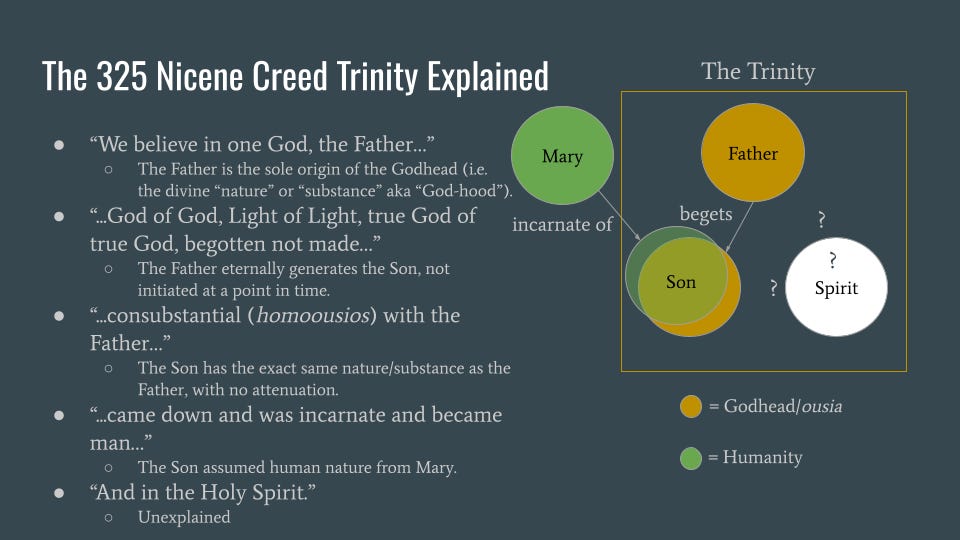
So this is a diagram explaining the Trinity as outlined at the council of Nicaea. The gold color indicates Godhead or the divine ousia or nature. Godhead is basically a term from old English for “God-hood”, that is, the attributes and state of being God. Similar to how you have person-hood, parent-hood, childhood, you have Godhood or Godhead. Now in evangelical contexts I’ve often seen Godhead used to refer to the Trinity as a whole. This is not the main purpose of this word and using it to refer to the entire Trinity can be imprecise and problematic as we will see. Green indicates human nature. So the first line of the Creed, “We believe in one God, the Father…”, identifies the one true monotheistic God as being the specific person of God the Father. What this means is that God the Father is the sole unoriginate entity in all existence, and the only producer of the Godhead substance that then flows to the Son. I will explain more about this specific doctrine on the next slide. But anyways, the next phrase, “...God of God, Light of Light, true God of true God, begotten not made…” indicates that the Father eternally generates the Son, so basically takes everything in his own existence and gives it to the Son, so that the Son has the exact same attributes that he has. Very important is that this process is not initiated at a point in time, but has happened at every point for eternity past. So therefore this is not God the Father creating God the Son, but rather God the Father generating or begetting God the Son. Again, I will explain this more on the next slide. Now the key phrase, “consubstantial (homoousios) with the Father”, means that the Son has the exact same nature/substance as the Father, with absolutely no attenuation. Then we have “came down and was incarnate and became man”, which is basically that the Son also assumed a human nature from Mary in addition to his divine nature, so he is both fully God and fully Man. And finally, we have the phrase “And in the Holy Spirit”, which basically leaves the matter of the Holy Spirit completely explained in the Nicene creed. So we have the Spirit floating here in an unknown state.
325 Nicene Cosmology
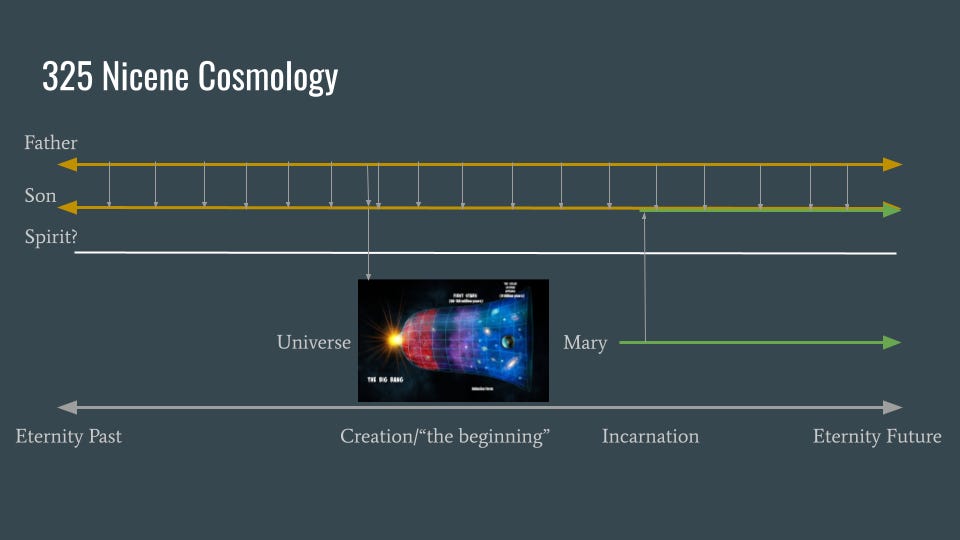
Taking a look at the cosmological timeline, we see that the Father and Son exist together at all points in eternity past and eternity future, the Son continuously flowing out of the Father. Together, the Father and Son create the universe, and then at some point the Son comes down into creation and is incarnate of Mary. Again, we don’t know what the Holy Spirit is doing yet. Now already, look at how much more compelling a God this is compared to the Arian situation. Instead of existing in complete loneliness for basically his entire existence, God instead exists as a community of two people, in perfect, familial love for each other. Again, to portray the whole scale of eternity. Compare the size of a grain of sand to the size of the entire universe. Eternity is that big, but then infinitely more so. Our minds cannot even fathom how long eternity is. So the vast majority of God’s existence is just this community of Father and Son, just existing and loving each other. And you know what, I think that’s a very beautiful thing. You know, I was recently reflecting on this with my 3 month old son, Oliver. Oliver is at this perfect age where every morning, when he sees me for the first time, he just locks into full eye contact and gives me the biggest, brightest smile you could ever imagine. And every single time I see that, my heart just melts without fail. I think that’s just a fraction of the love that the Father and Son experience together. And you know, if my eternal existence was just me, my wife, and my son, looking into each other’s eyes for all eternity and smiling, you know that would be a pretty awesome existence. And this realization actually made me very sad in a way, because I think this smiley period of Oliver is going to be too short, it will probably be over in months, and in the bigger picture I’m only going to have like 18 years in his life until I see him a lot less. I think I get very jealous of the Trinity, and how they just get to exist in perfect love together, forever. And so I think just this idea of an eternally existing community of love is such a beautiful picture of who God is and what the fundamental reality of our universe is. It’s amazing.
Note on Eternal Generation of the Son
So just a note on the eternal generation of the Son. So during this time period, everyone unanimously asserted that God the Father was the sole unoriginate entity, and that the Father continuously and eternally generated the existence of the Son. And the reason for this is that in classical monotheism, there can only be one unoriginate entity. So let’s say that you didn’t have this continuous begetting relationship and instead the Father and Son just existed forever together in eternity past. Well according to monotheism, you can’t have that, that’s really polytheism and a no-no. So the Son has to be dependent on the Father for his existence. This doctrine is known as “Monarchy of the Father”, and is summarized in this quote by Gregory of Nazianzus, who worked on the final version of the Creed: “when we look towards the Godhead and the first cause and the monarchy One [the Father] appears to us, but when towards those in which the Godhead subsists and which derive timelessly and with equal honor from the first cause, there are Three to be worshipped.” And anyways this is supported by scripture by many verses that talk about the Son receiving his nature from the Father, such as John 5:26 - “For just as the Father has life in himself, so he has granted the Son also to have life in himself.” An analogy of this that the fathers used is that of a light eternally emitting a ray of light. So imagine that you have some eternally existing light source; because it is a light source, it is in its very nature to then have to emit light, so that means at all points in eternity past you have the light source existing as well as the ray of light flowing out from it. And yes, I realize this was one of the bad analogies covered in the St. Patrick video. The difference is that, to the ancients, a light source and a ray of light had the same substance as each other, and this process happens eternally in time, so the ray of light is equal to the light source and isn’t said to be created in any way. I know in the modern mind we know the light source is something like a combustion reaction or electrons moving, and that the light ray is photons, but put yourself in the ancient mindset. To them, these things were the same substance.
So They All Lived Happily Ever After, Right?
Well, no they didn’t! In fact, in the following decades we will actually see a widespread rejection of the council of Nicaea in the church, and the retaliation of the Arians to take back control. However, we will cover this in part II and for now pause the presentation. I will be posting part II shortly which will follow the historical events involving the pushback against Nicaea, and then eventually the vindication of Nicaea at the Council of Constantinople. Hope to see you there, and God Bless!


