

My wife imprinted on our son Oliver the moment he was born (07/10/26 at 12:29am).
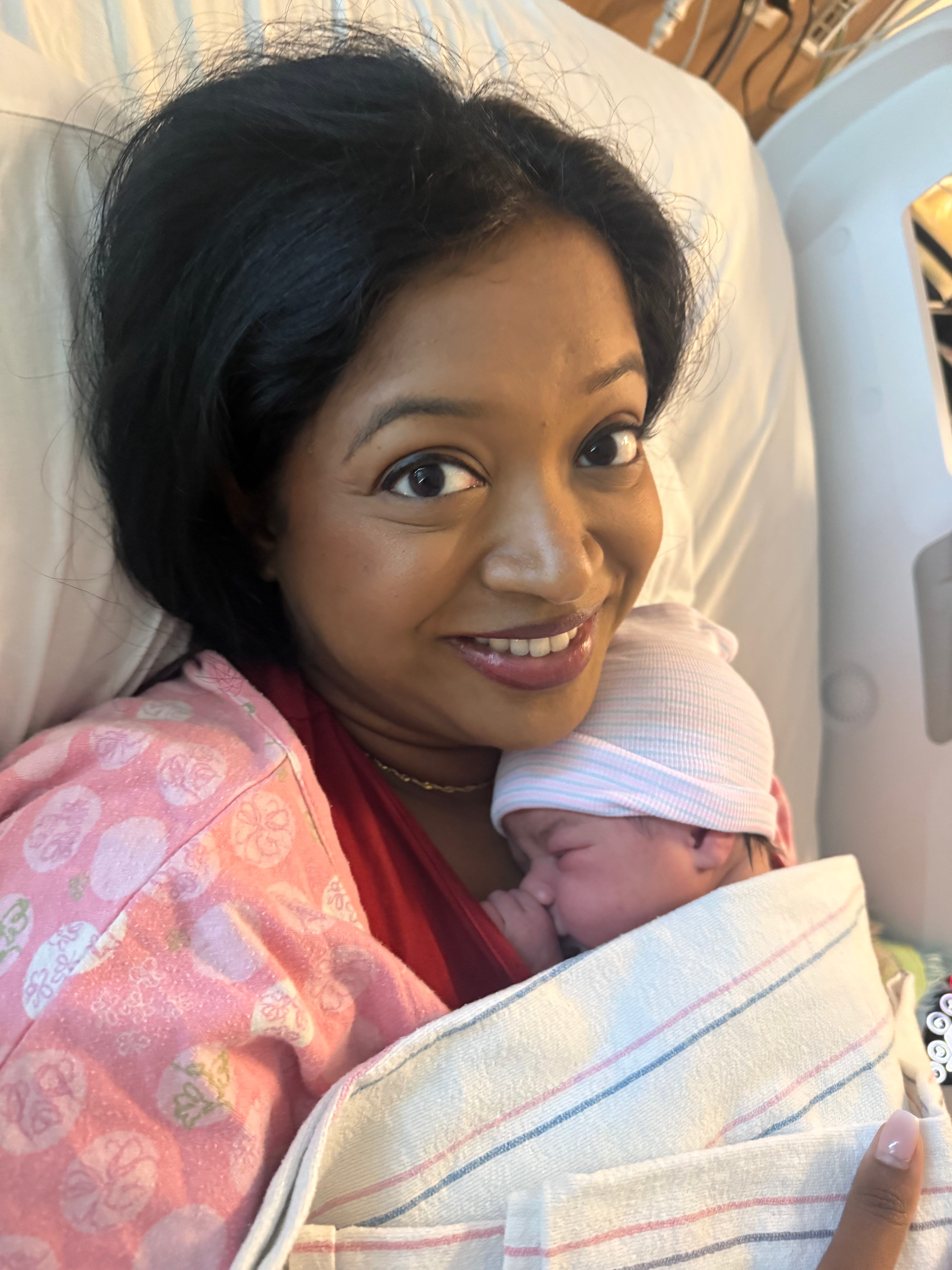
She had endured a long, stressful labor (more on this in a future post). But after 39 weeks of pregnancy punctuated by more than 20 hours in the hospital, her tears of pain turned to tears of joy the moment Oliver emerged. “It was all worth it for you, I would do it all again in a heartbeat” she said.
Obviously I was overjoyed at the birth and beyond excited to finally see my son. But my “imprinting” moment came about 12 hours later.
Fast forward to noon the next day. I was sitting in the recovery room with my wife and her family, with Oliver on my lap. I was on the verge of a mental breakdown. I had slept for 4 hours in the last 2 days, with still no chance for sleep yet on the horizon. My wife was not out of the woods yet, battling an infection and recovering from significant injuries inflicted by the delivery process. Oliver’s temperature had been low, sparking concerns that the infection had spread to him as we struggled to keep him warm. And we were bombarded with a non-stop firehose of new information from nurses and orderlies, covering everything from how to properly change his diaper and swaddle him, to making sure he doesn’t suffocate in his sleep. I have ADHD and often struggle with holding my focus; combined with the sleep deprivation and the adrenaline of the labor process wearing off, this resulted in me making mistakes (e.g. not fully wiping off poop from a dirty diaper) for which I was scolded by the nurses.
Minutes earlier I had locked myself in a bathroom, sitting on the ground with my head in my hands, just to find breathing space and trying (unsuccessfully) to put my nervous system out of fight-or-flight mode. I was shaking. My mind was a fog. I can’t do this. I have no idea what I’m doing. I don’t deserve to be a father. Nonetheless, I was forced to emerge shortly after without finding respite, because Oliver had completed his latest feeding and needed to be burped. I picked up Oliver from my wife and then sat down in a chair to attempt one of the burping positions the nurses had taught me.
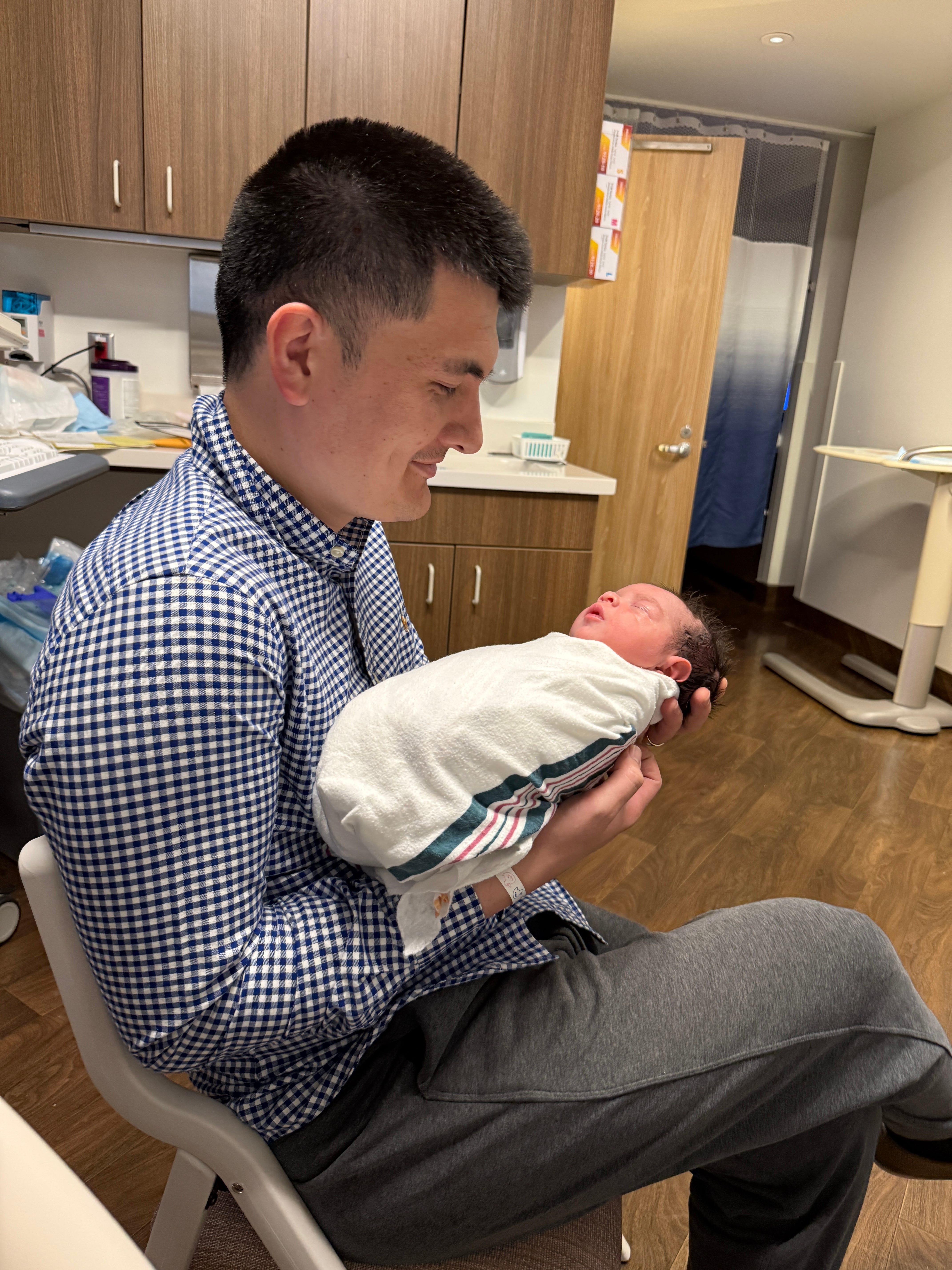
But as I held him in my arms, I experienced something I will never forget. First, he opened his eyes and looked at me in an expression of pure helplessness and trust, like this (picture taken days later but captures the same expression):

Second, my father in law began singing “He’s got the whole world in His hands, He’s got the whole world in His hands…”.
My spirit was instantly overwhelmed with an indescribable wave of peace, joy, and love. I was struck by three simultaneous observations:
At that moment, Oliver was my whole world. I loved him completely and utterly.
This is the exact same love God the Father has for the Son. I was experiencing the divine communion within the Trinity itself.
This is also the exact same love God has for us. As much as I saw my son’s helplessness and utterly desired to protect him, so too is God’s heart for us. I felt the suffocating stress of the situation momentarily lift off my shoulders.
For an instant, the shared gaze between me and my son produced an infinity mirror effect where I saw, recursively, him, myself, God the Son, and God the Father in alternating succession; I had to fight back tears. Later on, when I was alone with my wife, the tears came. “I promise you, I will do anything for our son” I choked out through sobs. I knew that the unconditional love (agape) I felt for Oliver would abide in me for the rest of my life.
1. The Experience of Unconditional Love
Over the past few weeks, I’ve reflected on how strange the parent-child relationship is compared to other interpersonal relationships. Most human relationships involve some give-and-take, and/or mutual respect and admiration. For example, I love my wife because of specific traits she manifests: spiritual wisdom, kindness, intelligence, etc. (this is a long list). We also have specific shared experiences over the course of a ten year relationship that we bond over. And we mutually support each other through our married life.
My relationship with Oliver is missing these concrete elements. His personality hasn’t developed yet, we don’t really have many memories together, and our relationship is pretty one-sided in that I provide everything for him for nothing in return. Nonetheless, I love him fully and unconditionally, so much that I would die for him. There is no underlying reason for this love, except the sake of love itself. His purpose of existence is to receive love and nourishment, and ours is to give it, and it is a beautiful thing.
I have faith that the human ability to feel agape love comes from the image of God (Imago Dei) given to us at creation. While I acknowledge there is probably an evolutionary explanation providing a mechanical reason for why this love exists, this doesn’t concern me. I care about the teleological reason (the why), not the mechanical reason (the how). God in his providence is capable of orchestrating any physical process, evolutionary or otherwise, towards his ultimate creative purpose.
2. The Divine Communion of the Trinity
Not only is the parental, nourishing love I experienced a defining trait of God’s divine energy; this is exactly the type of love God the Father actively expresses for God the Son. We know from Nicaea that the One God, the Father, eternally generates God the Son out of his divine nature:
“We believe in one Lord, Jesus Christ, the only Son of God, eternally begotten of the Father, God from God, Light from Light, true God from true God…”
In other words, there is a causal relationship between the Father and the Son, a doctrine known as eternal generation or Monarchy of the Father. The Nicene fathers rooted these doctrines in scriptures such as John 5:26, Proverbs 8:25, and Micah 5:2. Saint Gregory Nazianzen, one of the architects of the Nicene Creed in its completed form, elucidates this doctrine in his Fifth Theological Oration:
“when we look towards the Godhead and the first cause and the monarchy One appears to us, but when towards those in which the Godhead subsists and which derive timelessly and with equal honor from the first cause, there are Three to be worshipped.”
(Note that eternal generation of the Son is not the same as creation of the Son, which would imply Arianism (“there was a time when the Son was not”), the heresy the Nicene fathers staunchly opposed. The Father and Son always existed together in eternity past.)
The doctrine of Monarchy of the Father protects the Trinity from collapsing into polytheism by rooting the Trinity’s existence in God the Father, who alone out of the three persons is agennetos (unbegotten; in Catholic theology this is a se). Furthermore, this doctrine profoundly reveals the love expressed in the inner community of the Trinity. The “One God, the Father” (per Nicaea) is completely self-sufficient and complete in his own individual being, lacking nothing. Nonetheless, for no sake other than the sake of love, He still spontaneously and eternally generates the Son, Jesus, as his own exact, undiminished image (Hebrews 1:3). And the Father does not perform any action in the universe alone, despite being perfectly capable to do so; he does EVERYTHING with and through his Son (Hebrews 1:2). To the theologian Fr. Zizioulas, this proves that:
“love is not an emanation or ‘property’ of the substance of God…but is what He is, the one God. Thus love ceases to be a qualifying—i.e. secondary—property of being and becomes the supreme ontological predicate. Love as God’s mode of existence ‘hypostasizes’ God, constitutes His being.”
This love within the trinity has direct parallels within human parenthood. Becoming a parent doesn’t increase the dollar amount of output I produce in the economy, enable me to make more creative works, or give me more time and energy to pour into my community. In fact, parenthood reduces my capacity in each of these areas. So you could say my wife and I were “self-sufficient” in these areas, yet for no sake other than love still decided to have a child. As a result, we have the opportunity to completely pour into and nourish (in a manner of speaking “generate”) a developing human soul. And even though my wife and I could continue doing our activities in life apart from our son, by contrast we look forward to doing things “with and through” our son (even if technically we may do these things “worse” as a result). For example, I look forward to teaching my son about work, about music, and about God and the Church. The point isn’t necessarily that I or my son achieves highly in these areas (although this is still a hope). Getting to do these things in relationship IS ITSELF the joy and the beauty. Love is, as Zizioulas says, “the supreme ontological predicate”.
3. Receiving God’s Love through the Incarnation
The divine and human agape loves are not confined to these parallel lines. For those of us adopted into God’s family, we have assurance that the Father extends the same love to us as he does towards his Son. The moment of adoption occurs at the moment of our baptism, together with a profession of faith, which St. Paul states is the mechanism by which we enter into Christ:
“Or do you not know that as many of us were baptized into Christ Jesus were baptized into His death? Therefore we were buried with Him through baptism into death, that just as Christ was raised from the dead by the glory of the Father, even so we also should walk in newness of life. For if we have been united together in the likeness of His death, certainly we also shall be in the likeness of His resurrection.” (Romans 6:3-5).
Having entered into God’s family through faith and baptism, we are called to abide through continual repentance from our sin (Romans 6:12-13).
As an aside, this view on baptism as literally salvific is called Baptismal Regeneration, which many evangelical readers may disagree with (preferring to take a symbolic view). I will not fully justify Baptismal Regeneration in detail here (maybe I will do so in a future post). However, to summarize, all the rhetoric regarding baptism in the Bible categorizes it as a literal, salvific and regenerative act, and nowhere is the ritual called symbolic. From history, we clearly see that all Christians from the second century onward regarded baptism as literally regenerative. Furthermore, the historical scholarly consensus actually pushes the regenerative view of baptism back into the first century to the Biblical authors themselves. To quote historian Bart Ehrman:
“For Paul the act was not simply significant as a symbolic statement that a person’s sins had been ‘cleansed’ or that he or she had entered into a new life. The act involved something that really happened. When people were baptized, they actually experienced a union with Christ and participated in the victory brought at his death (in the immersion under the water; see esp. Rom 6:1-11).”
So when most historians read Romans 6, they see that Paul views baptism as an efficacious act that literally binds one to Christ, and not as merely symbolic. In my opinion, we should use the historical authorial intent as the starting point when interpreting scripture.
The literal regenerative view of baptism explains why Jesus himself needed to be baptized. Jesus did not go to John the Baptist to be baptized for his own benefit, as he had no sins to be forgiven. On the contrary, his baptism prefigured and eternally blessed the sacrament of baptism for us; typologically, this maps to Moses leading the Israelites through the waters of the Red Sea (1 Corinthians 10:2). Baptism becomes the grounds in which we can encounter the Incarnation firsthand, refreshing the Imago Dei in us. St. Athanasius describes this in On the Incarnation:
“For as, when the likeness painted on a panel has been effaced by stains from without, he whose likeness it is must needs come once more to enable the portrait to be renewed on the same wood: for, for the sake of his picture, even the mere wood on which it is painted is not thrown away, but the outline is renewed upon it; in the same way also the most holy Son of the Father, being the Image of the Father, came to our region to renew man once made in His likeness, and find him, as one lost, by the remission of sins; as He says Himself in the Gospels: ‘I came to find and to save the lost.’ Whence He said to the Jews also: ‘Except a man be born again, not meaning, as they thought, birth from woman, but speaking of the soul born and created anew in the likeness of God’s image.’”
Therefore, when we are baptized today we literally join ourselves to Christ, meet him in the moment where he emerges from the waters, and alongside him equally receive the words “You are My beloved Son, in whom I am well pleased”. The exact same agape love from the Father to the Son has been commuted to those of us who are baptized.
How Then Shall We Live?
My son is 1 month old now, and while some days are harder than others, I consider every moment joyful. Seeing even the smallest developments from him, whether starting to giggle and make facial expressions to exhibiting better neck control, make all the 3am feedings, lack of sleep, diaper changes, and blowouts instantly worth it. I know these little moments with my son will never get old.
For anyone with kids, parents, or family: cherish every little moment you get in this life to experience agape love. It is a gift from God and something truly sacred.
For baptized Christians: no matter the circumstance, know in your heart that the Father’s face shines on you with the same love he has for his Son. You are beloved.
For un-baptized Seekers (specifically, Catechumens): May your faith journey be blessed as you follow God’s call to completion. In the words of St. Cyril of Jerusalem:
Already there is an odour of blessedness upon you, O you who are soon to be enlightened : already you are gathering the spiritual flowers, to weave heavenly crowns: already the fragrance of the Holy Spirit has breathed upon you: already you have gathered round the vestibule of the King's palace ; may you be led in also by the King! For blossoms now have appeared upon the trees ; may the fruit also be found perfect!…Great is the Baptism that lies before you : a ransom to captives; a remission of offenses; a death of sin; a new-birth of the soul; a garment of light; a holy indissoluble seal; a chariot to heaven; the delight of Paradise; a welcome into the kingdom; the gift of adoption!
For non-Christians: thank you so much for taking the time to read this theological blog post! I hope you found it interesting, and I am happy to discuss more with you and answer any questions at theosizing@substack.com! God “desires all people to be saved and to come to the knowledge of the truth” (1 Timothy 2:4), and therefore extends to you the invitation to join his family. My hope is that you will one day join the Church of the apostles, become baptized, and come to know Christ. I will end with an exhortation from St. Silouan the Athonite:
“The soul that is surrendered humbly to God’s will invisibly beholds God every second, yet finds no words for all this even to herself and cannot describe it, but only by experience learns to know the mercy of God and know when the Lord is with her. The soul is surrendered to Him like a little child who receives food every day but is ignorant from whence comes this food. Thus it is with God the soul feels all is well but cannot explain this. Oh Lord by Thy Holy Spirit enlighten thy people that all may know Thy love!”